 Flooring Cost Calculator
Introduction
Luxury vinyl plank and laminate flooring are two of the most popular alternatives to traditional hardwood. Both can provide an attractive wood-look appearance at a more accessible price point, and both are available in a wide range of colors, plank sizes, textures, and styles.
At first glance, the two flooring types can look remarkably similar. Modern manufacturing techniques allow both luxury vinyl plank and laminate to reproduce the appearance of oak, walnut, hickory, maple, and other natural wood species with impressive detail.
However, the similarities largely end at appearance.
Luxury vinyl plank and laminate are constructed from different materials, respond differently to moisture, and can have different requirements for installation, maintenance, and long-term use. The best option for your home depends on where the flooring will be installed, your household lifestyle, your budget, and the performance characteristics you value most.
Luxury vinyl plank—commonly called LVP—is particularly popular because of its moisture resistance and versatility. Laminate, meanwhile, is valued for its realistic wood appearance, durable surface, and affordability.
Neither flooring material is universally better than the other.
This guide compares luxury vinyl plank and laminate flooring in detail, including cost, durability, moisture resistance, comfort, appearance, installation, maintenance, repairability, and long-term value, to help you decide which option is the better fit for your home.
Quick Answer
For most homeowners:
- Luxury vinyl plank is generally better for moisture-prone areas.
- Laminate can provide an exceptionally realistic wood-look surface.
- Both materials are relatively affordable alternatives to hardwood.
- Both are available in DIY-friendly floating floor systems.
- LVP is commonly used in kitchens, basements, and other areas where moisture may be a concern.
- Laminate is particularly popular in living rooms, bedrooms, dining rooms, and other relatively dry areas.
- Both can offer good durability when you select a quality product and install it correctly.
If moisture resistance is your highest priority, luxury vinyl plank usually has the advantage.
If your priority is achieving a convincing wood appearance in a relatively dry room while controlling costs, laminate may be an excellent choice.
The specific product matters just as much as the flooring category, so always compare manufacturer specifications before purchasing.
What Is Luxury Vinyl Plank Flooring?
Luxury vinyl plank is a resilient flooring product designed primarily to replicate the appearance of hardwood.
Unlike traditional sheet vinyl, LVP is manufactured in individual planks.
A typical luxury vinyl plank product may include several layers, such as:
- Protective wear layer
- Printed design layer
- Core layer
- Backing layer
Some products also include attached underlayment.
Construction varies significantly between manufacturers and product lines.
Popular LVP styles imitate:
- Oak
- Hickory
- Maple
- Walnut
- Pine
- Reclaimed wood
Higher-quality products may include detailed textures and embossed surfaces designed to correspond with the printed wood grain.
LVP is popular because it combines attractive design with practical performance.
What Is Laminate Flooring?
Laminate is another manufactured flooring product designed to reproduce the appearance of natural materials.
A typical laminate plank includes:
- Protective wear layer
- Decorative image layer
- High-density core
- Stabilizing backing
The decorative layer can reproduce detailed wood grain patterns, while the surface texture may add additional realism.
Modern laminate is available in designs that imitate:
- Hardwood
- Natural stone
- Tile
However, wood-look laminate remains particularly popular.
Laminate flooring is commonly installed using a floating click-lock system in which planks connect to one another rather than being permanently attached to the subfloor.
LVP vs. Laminate: Appearance
Appearance is one of the main reasons homeowners consider either material.
Both can provide convincing alternatives to natural hardwood.
Luxury Vinyl Plank
Modern LVP can reproduce:
- Wood grain
- Knots
- Saw marks
- Natural color variation
- Distressed textures
Higher-quality products may use larger pattern variations to reduce obvious repetition across the floor.
Laminate
Laminate is also capable of producing highly realistic wood designs.
Because of its detailed photographic design layer and textured surface, premium laminate can closely imitate natural wood.
Some homeowners prefer the visual depth and surface feel of high-quality laminate when trying to recreate a traditional hardwood appearance.
Which Looks Better?
There is no universal winner.
Both categories range from basic products to premium designs.
Rather than comparing LVP and laminate in general, compare individual samples side by side in your home.
Lighting, plank size, texture, and color can significantly influence how realistic the finished floor appears.
LVP vs. Laminate: Cost
Both luxury vinyl plank and laminate are generally positioned as more affordable alternatives to many traditional hardwood products.
However, pricing varies significantly depending on:
- Brand
- Product quality
- Plank thickness
- Wear layer
- Core construction
- Attached underlayment
- Design quality
- Warranty
Installation costs also depend on the project.
Your complete flooring budget may include:
- Flooring material
- Extra material for cuts and waste
- Existing flooring removal
- Disposal
- Subfloor preparation
- Underlayment
- Professional installation
- Baseboards
- Transitions
Comparing only the material price per square foot can therefore be misleading.
A lower-priced flooring product may require additional preparation or underlayment that increases the total project cost.
Always compare the total installed price when deciding between flooring options.
LVP vs. Laminate: Moisture Resistance
Moisture performance is one of the biggest differences between these flooring types.
Luxury Vinyl Plank
Many LVP products provide excellent moisture resistance.
Certain products are marketed as waterproof and can be suitable for rooms such as:
- Kitchens
- Laundry rooms
- Basements
- Mudrooms
Some LVP products may also be appropriate for bathrooms when installed according to manufacturer requirements.
However, waterproof flooring does not mean the entire flooring system or room is protected from water damage.
Water can still potentially:
- Travel beneath flooring
- Damage the subfloor
- Affect walls
- Create moisture problems
Leaks and standing water should always be addressed promptly.
Laminate
Traditional laminate flooring has historically been more vulnerable to water exposure because moisture can affect the wood-based core.
Excessive moisture may potentially cause:
- Swelling
- Edge damage
- Warping
- Joint deterioration
Newer water-resistant and waterproof-rated laminate products have improved moisture performance considerably.
However, specifications vary by manufacturer.
Winner for Moisture Resistance
In general, luxury vinyl plank has the advantage.
For moisture-prone areas, verify that the specific product is approved for the intended location.
LVP vs. Laminate: Durability
Both flooring types can provide good durability.
However, durability depends heavily on product quality and household conditions.
Luxury Vinyl Plank
Quality LVP is designed to resist everyday wear.
It can perform well in homes with:
- Children
- Pets
- Frequent foot traffic
The wear layer plays an important role in protecting the printed design beneath it.
Laminate
Laminate can also offer excellent resistance to everyday surface wear.
Its protective top layer is designed to withstand regular residential traffic.
High-quality laminate can perform well in:
- Living rooms
- Hallways
- Dining rooms
- Bedrooms
Which Is More Durable?
There is no simple universal winner.
A premium laminate product may outperform a low-quality LVP product, and vice versa.
Consider the specific product's:
- Wear rating
- Construction
- Warranty
- Intended use
Product quality is critical when comparing durability.
LVP vs. Laminate: Scratch Resistance
Scratch resistance is particularly important for households with pets, children, or frequently moved furniture.
Both LVP and laminate are designed to resist normal household wear.
Laminate's hard protective surface can provide excellent scratch resistance in many products.
LVP can also perform well, particularly when it has a high-quality wear layer.
However, neither material is scratch-proof.
Potential causes of scratches include:
- Pet claws
- Furniture
- Dirt
- Sand
- Heavy objects
Using furniture pads and regularly removing abrasive debris can help protect either flooring type.
LVP vs. Laminate for Pets
Both materials can be practical choices for pet owners.
LVP Advantages for Pets
LVP may offer:
- Strong moisture resistance
- Easy cleanup
- Good durability
- Comfortable surface
Moisture resistance can be particularly helpful when dealing with:
- Water bowls
- Wet paws
- Pet accidents
Laminate Advantages for Pets
Quality laminate may provide:
- Strong scratch resistance
- Easy routine cleaning
- Durable wear surface
However, spills and accidents should be cleaned promptly, particularly with products that are not rated for extended water exposure.
Which Is Better for Pets?
For households where moisture and pet accidents are major concerns, LVP generally has the advantage.
For households primarily concerned about surface scratches, a high-quality laminate product may also perform very well.
LVP vs. Laminate for Children
Family flooring needs to withstand:
- Spills
- Toys
- Heavy activity
- Dropped objects
- Frequent cleaning
Both materials can be suitable.
LVP's moisture resistance may make cleaning spills less stressful.
Laminate can provide a durable surface for everyday family use.
For play areas where children spend time sitting on the floor, homeowners may also want to compare the comfort and temperature of individual products.
LVP vs. Laminate: Comfort Underfoot
Both materials are generally more forgiving than hard tile surfaces, although the exact feel varies by product and installation system.
LVP
LVP can feel slightly resilient underfoot.
Some products include attached padding or are installed over compatible underlayment.
Laminate
Laminate can also feel comfortable, particularly when installed with appropriate underlayment.
However, some floating laminate floors may produce a different sound or feel when walked on.
Which Is More Comfortable?
The difference depends heavily on:
- Product thickness
- Core construction
- Underlayment
- Subfloor
Testing samples in person can help you compare the feel of different products.
LVP vs. Laminate: Noise
Noise can be an important consideration, particularly in:
- Multi-story homes
- Apartments
- Bedrooms
- Home offices
Floating floors can sometimes produce footfall noise.
The acoustic performance depends on:
- Flooring construction
- Underlayment
- Subfloor
- Installation quality
Some products include attached acoustic backing.
If sound reduction is important, review the manufacturer's acoustic specifications and any building requirements that may apply to your property.
LVP vs. Laminate: Installation
Both LVP and laminate are available in floating click-lock systems.
This makes them popular for both professional and DIY installations.
LVP Installation
Depending on the product, LVP may be:
- Click-lock floating
- Glue-down
The subfloor generally needs to be:
- Clean
- Dry
- Stable
- Properly prepared
Significant imperfections may become visible or affect the flooring over time.
Laminate Installation
Laminate is commonly installed as a floating floor.
Planks connect using locking edges.
The installation may require:
- Underlayment
- Expansion gaps
- Proper subfloor preparation
Manufacturer instructions should always be followed.
Which Is Easier to Install?
Both can be relatively straightforward compared with some traditional flooring materials.
However, room shape, doorways, stairs, transitions, and subfloor condition can significantly increase project complexity.
LVP vs. Laminate: Subfloor Preparation
Regardless of which material you choose, proper subfloor preparation is essential.
Potential subfloor problems include:
- Uneven areas
- Cracks
- Moisture
- Loose sections
- Debris
- Old adhesive
Installing flooring over an unsuitable surface can contribute to:
- Movement
- Joint failure
- Uneven appearance
- Noise
- Premature wear
Never assume that choosing a floating floor eliminates the need for subfloor preparation.
Your installer should evaluate the floor before installation begins.
LVP vs. Laminate: Maintenance
Both flooring materials are relatively easy to maintain.
LVP Maintenance
Routine care typically includes:
- Sweeping
- Vacuuming
- Damp cleaning with approved products
- Prompt spill cleanup
Avoid cleaning products or methods not recommended by the manufacturer.
Laminate Maintenance
Routine care generally includes:
- Sweeping
- Vacuuming
- Cleaning with manufacturer-approved products
- Prompt spill cleanup
Excessive water should generally be avoided unless the manufacturer specifically approves the cleaning method.
Which Is Easier to Maintain?
Both are relatively low maintenance.
LVP may have an advantage in households where frequent spills or moisture are concerns.
LVP vs. Laminate: Repairability
Neither LVP nor laminate can typically be refinished like traditional hardwood.
If a plank becomes severely damaged, replacement may be necessary.
With floating installations, replacing a plank may require disassembling part of the floor from the nearest wall.
Other repair methods may be possible depending on the flooring system.
Keeping leftover planks after installation is highly recommended.
Products may eventually be:
- Discontinued
- Redesigned
- Produced in different colors
- Unavailable locally
An exact match may become difficult to find several years later.
LVP vs. Laminate: Lifespan
The lifespan of either flooring type depends on:
- Product quality
- Installation
- Foot traffic
- Maintenance
- Moisture exposure
- Household conditions
Higher-quality products generally provide better long-term performance than entry-level alternatives.
Neither material should automatically be considered a lifetime floor.
However, both can provide many years of service when properly selected and maintained.
Review product warranties carefully, but remember that warranty length does not necessarily equal expected lifespan.
Warranty coverage may include specific conditions and exclusions.
LVP vs. Laminate in the Kitchen
Kitchens experience:
- Spills
- Food debris
- Frequent cleaning
- Heavy traffic
- Potential appliance leaks
Both materials may be used in kitchens if approved by the manufacturer.
However, LVP generally has an advantage because of its moisture-resistant construction.
Winner for Kitchens
For most homeowners prioritizing moisture performance, LVP.
LVP vs. Laminate in the Bathroom
Bathrooms experience frequent moisture and occasional standing water.
Certain LVP products may be approved for bathroom installations.
Laminate products vary significantly in moisture performance.
If considering either material for a bathroom, verify the manufacturer's installation requirements and warranty conditions.
Tile remains another popular option for bathrooms.
Winner
Between these two options, appropriately rated LVP generally has the advantage.
LVP vs. Laminate in the Living Room
Both materials can perform well in living rooms.
Laminate may appeal to homeowners seeking:
- Realistic wood appearance
- Durable surface
- Affordable pricing
LVP may appeal to homeowners seeking:
- Easy maintenance
- Moisture resistance
- Versatility
Winner
Tie, depending on your priorities.
LVP vs. Laminate in Bedrooms
Both materials are suitable for many bedrooms.
Bedrooms generally experience:
- Lower moisture
- Moderate traffic
- Less demanding conditions
Laminate can provide an attractive wood-look surface at an accessible price.
LVP can provide similar visual appeal with additional moisture resistance.
Area rugs can add warmth and comfort to either option.
Winner
Tie for most bedrooms.
LVP vs. Laminate in Basements
Basements may have unique moisture concerns.
LVP is often considered for basement installations because many products provide strong moisture resistance.
However, installing moisture-resistant flooring does not solve an underlying basement moisture problem.
Before installation, investigate:
- Water intrusion
- Concrete slab moisture
- Leaks
- Drainage issues
Winner for Basements
Generally, LVP, assuming the selected product is approved for below-grade installation and existing moisture issues have been addressed.
LVP vs. Laminate for High-Traffic Areas
Both flooring materials are available in products designed for high residential traffic.
When comparing options, consider:
- Wear layer or wear rating
- Manufacturer specifications
- Warranty
- Intended application
For entryways where moisture and outdoor debris are common, LVP may provide an advantage.
For dry hallways and living spaces, quality laminate can also perform exceptionally well.
LVP vs. Laminate: Resale Appeal
Both materials can improve the appearance of a home when replacing:
- Worn carpet
- Damaged flooring
- Outdated surfaces
Neither is generally viewed in exactly the same way as authentic hardwood.
However, modern high-quality products can create attractive interiors with broad buyer appeal.
The greatest value usually comes from:
- Choosing a quality product
- Selecting a neutral design
- Installing it professionally
- Using it in appropriate rooms
- Maintaining it properly
A well-installed mid-range floor may create a better impression than a premium product with poor installation.
LVP vs. Laminate: Long-Term Value
Long-term value depends on more than purchase price.
Consider:
- Material cost
- Installation cost
- Maintenance
- Durability
- Repairability
- Expected lifespan
- Suitability for the room
If a moisture-sensitive product is installed in an inappropriate area and requires early replacement, the lower initial price may not represent good value.
Choosing the correct flooring for the environment is often more important than choosing the least expensive option.
Which Is Better for an Entire House?
LVP is often selected for continuous flooring throughout multiple areas because of its versatility and moisture resistance.
It may allow homeowners to use a consistent flooring appearance across:
- Living rooms
- Kitchens
- Hallways
- Bedrooms
However, installation requirements vary, particularly across large continuous spaces.
Laminate can also work well throughout many dry living areas.
Some homeowners combine:
- Laminate in living rooms and bedrooms
- LVP in kitchens and moisture-prone areas
- Tile in bathrooms
The best approach depends on your desired appearance and the requirements of each room.
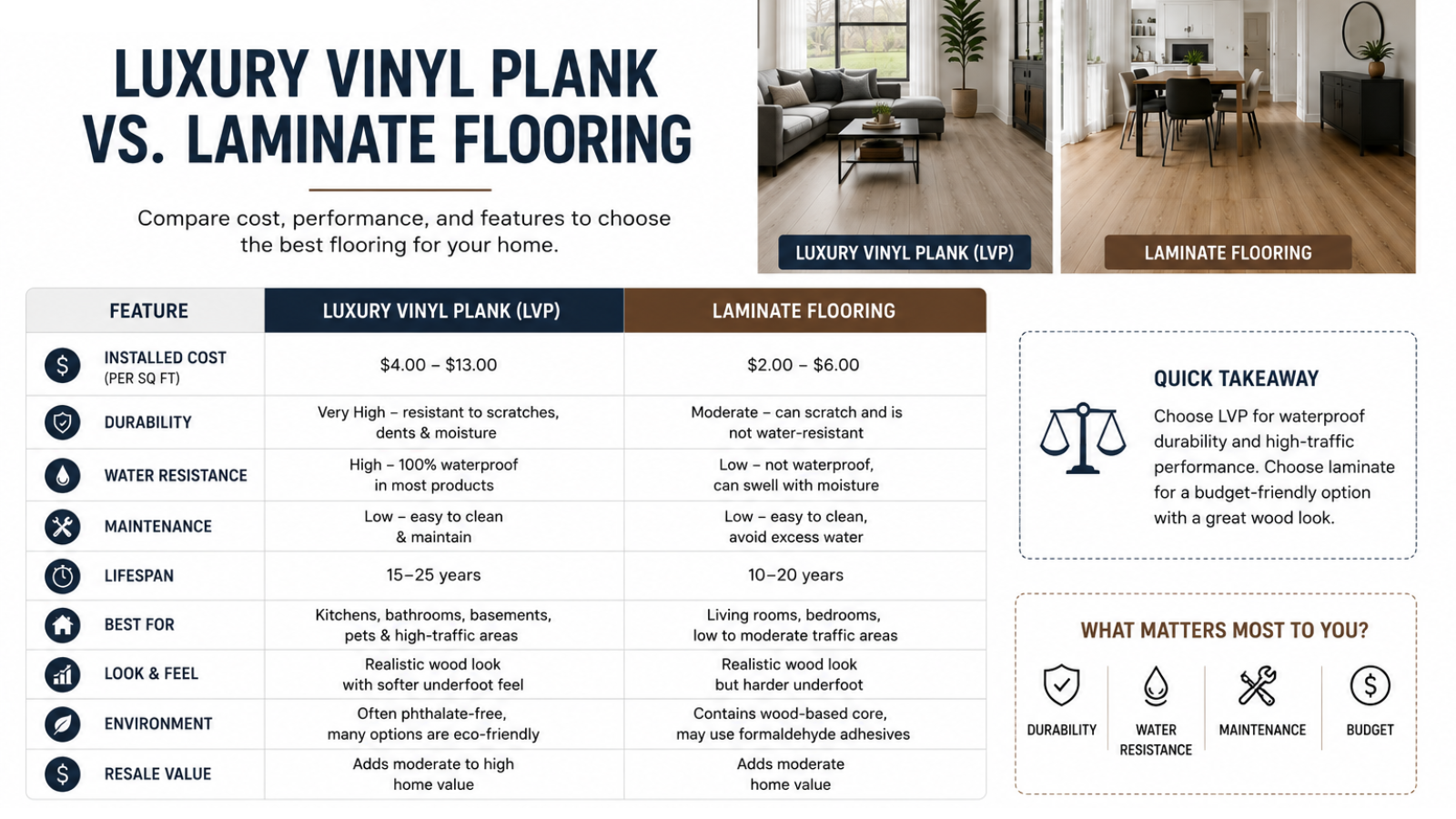
Luxury Vinyl Plank vs. Laminate at a Glance
| Feature | Luxury Vinyl Plank | Laminate Flooring |
|---|---|---|
| Wood-Look Appearance | Excellent | Excellent |
| Moisture Resistance | Excellent for many products | Varies by product |
| Scratch Resistance | Very Good | Very Good to Excellent |
| Routine Maintenance | Low | Low |
| Comfort | Good | Good |
| DIY Installation | Often Possible | Often Possible |
| Floating Installation | Available | Common |
| Glue-Down Option | Available for some products | Less common |
| Kitchen Suitability | Excellent for appropriate products | Product-dependent |
| Bathroom Suitability | Product-dependent, often better | Highly product-dependent |
| Basement Suitability | Often Excellent | Product-dependent |
| Refinishing | No | No |
| Pet-Friendly | Excellent | Very Good |
| Design Selection | Excellent | Excellent |
| Long-Term Value | Very Good | Very Good |
These comparisons are general. Individual product specifications should always guide your final decision.
Common Mistakes When Choosing Between LVP and Laminate
Homeowners can avoid disappointing results by watching for several common mistakes.
These include:
- Assuming all LVP products are waterproof.
- Assuming all laminate performs poorly around moisture.
- Choosing based only on price.
- Ignoring product quality.
- Failing to compare warranties.
- Ignoring subfloor preparation.
- Using flooring in a room not approved by the manufacturer.
- Forgetting underlayment requirements.
- Choosing based only on appearance.
- Ignoring installation costs.
- Failing to order extra material.
- Not keeping leftover planks for future repairs.
Always evaluate the specific product rather than relying only on general characteristics of the flooring category.
Questions to Ask Before Choosing
Before deciding between LVP and laminate, ask yourself:
- Which rooms am I flooring?
- Is moisture a concern?
- Do I have pets?
- Do I have children?
- How much foot traffic does the area receive?
- How important is scratch resistance?
- How important is realistic wood appearance?
- Will I install the flooring myself?
- Does the subfloor require preparation?
- Is underlayment required?
- How long do I expect to keep the flooring?
- What is my total installed budget?
Your answers can help narrow your options considerably.
Frequently Asked Questions
Is luxury vinyl plank better than laminate?
Not necessarily.
LVP generally provides stronger moisture resistance and can be more versatile across different rooms.
Laminate can provide excellent durability and an extremely realistic wood appearance.
The better option depends on where the flooring will be installed and your priorities.
Which is cheaper, LVP or laminate?
Both are available across a wide range of prices.
Entry-level and premium products exist in both categories.
Compare the total installed cost, including underlayment and subfloor preparation, rather than material prices alone.
Which is more waterproof?
Luxury vinyl plank generally has the advantage.
Many LVP products are marketed as waterproof, although the entire flooring system and subfloor are not automatically protected from water damage.
Laminate moisture resistance varies significantly by product.
Which is better for pets?
LVP is often preferred for homes with pets because of its combination of moisture resistance and easy cleaning.
High-quality laminate can also offer excellent scratch resistance.
Which is better for kitchens?
LVP generally has the advantage because kitchens are exposed to spills and potential moisture.
Always verify that the specific product is approved for kitchen installation.
Can laminate be installed in bathrooms?
Some newer laminate products may be approved for certain moisture-prone applications.
However, product specifications vary considerably.
Check manufacturer instructions and warranty requirements before installation.
Which flooring looks more like real hardwood?
Both can provide highly realistic wood designs.
Premium laminate is sometimes praised for detailed textures and wood reproduction, while high-quality LVP can also provide extremely convincing visuals.
Compare physical samples before deciding.
Which lasts longer?
The answer depends primarily on product quality, installation, maintenance, and household conditions.
A premium product from either category may outperform an inexpensive alternative from the other.
Can LVP or laminate be refinished?
Generally, no.
Unlike traditional hardwood, these flooring products are typically replaced rather than sanded and refinished when significantly worn or damaged.
Should I keep extra flooring?
Yes.
Keeping several planks or an unopened box can make future repairs easier if the original product is discontinued.
Final Verdict
Luxury vinyl plank and laminate flooring are both excellent options for homeowners seeking an attractive alternative to traditional hardwood without the same material and installation requirements.
Luxury vinyl plank is generally the stronger choice when moisture resistance and versatility are top priorities. It can work well in kitchens, basements, family living areas, and other rooms where spills or moisture may be a concern, provided the specific product is approved for the intended application.
Laminate flooring is an excellent option for homeowners who want a durable and realistic wood-look surface in relatively dry areas. Modern premium laminate can provide impressive texture and visual detail while remaining relatively easy to maintain.
For homes with pets, children, or frequent spills, LVP may offer a practical advantage.
For dry living rooms, bedrooms, and dining areas, either flooring type can be an excellent choice.
The most important factor is not simply whether you choose LVP or laminate. Product quality, proper subfloor preparation, correct installation, and choosing flooring appropriate for the room will have a major impact on long-term performance.
Final Thoughts
The decision between luxury vinyl plank and laminate flooring should begin with how and where the floor will be used.
If you are installing new flooring in a moisture-prone area, LVP's water-resistant construction may make it the more practical option. If you are updating a dry living space and want an affordable floor with a highly realistic wood appearance, laminate deserves serious consideration.
Before making a final decision, compare physical samples in your home. Look at them in natural and artificial light, walk on them if possible, and review the manufacturer's specifications for moisture resistance, wear performance, installation requirements, and warranty coverage.
Also consider the complete cost of your project. Flooring material is only one part of the investment. Existing flooring removal, disposal, subfloor preparation, underlayment, professional installation, trim, transitions, and extra material for waste can all affect your final budget.
Before requesting contractor estimates, use the Flooring Cost Calculator on the homepage to estimate your project's cost based on your room size, selected flooring material, and state. A personalized estimate can help you compare luxury vinyl plank and laminate flooring costs, establish a realistic project budget, and choose the option that provides the best combination of appearance, durability, moisture resistance, and long-term value for your home.