 Flooring Cost Calculator
Introduction
Hardwood flooring remains one of the most desirable flooring options for homeowners who want a natural, timeless appearance and long-term durability. From traditional oak floors to wide-plank walnut and hickory, hardwood can transform the appearance of a room while providing a surface that may last for decades when properly installed and maintained.
However, hardwood is also generally one of the more expensive residential flooring options.
The total cost of a hardwood flooring project depends on much more than the price of the wood itself. Homeowners may also need to budget for professional installation, additional flooring for cuts and waste, removal of existing floors, subfloor preparation, installation materials, trim, transitions, and other project-specific expenses.
Geographic location can also make a significant difference. Based on the 2026 state-level pricing used by the Flooring Cost Calculator, estimated installed hardwood flooring costs range from approximately $8 to $28 per square foot, depending on the state.
Within that broad range, the actual price of your project will depend on factors such as the hardwood species, product quality, plank dimensions, installation method, room complexity, and condition of the existing subfloor.
This guide explains hardwood flooring costs, the factors that affect pricing, and the additional expenses homeowners should consider when creating a realistic budget for a new hardwood floor.
Quick Answer
Based on the 2026 state-level pricing used by the Flooring Cost Calculator, estimated installed hardwood flooring costs range from approximately:
$8–$28 per square foot
At the lower end of the state-level pricing data, Arkansas and Mississippi have estimated hardwood costs of approximately:
$8–$14 per square foot
At the higher end, Hawaii has an estimated range of:
$17–$28 per square foot
Other relatively high-cost locations include:
- Alaska: $15–$25 per square foot
- California: $14–$24 per square foot
- New York: $14–$24 per square foot
- Washington: $13–$23 per square foot
- Massachusetts: $13–$22.50 per square foot
Actual project costs may vary based on local pricing and the specific requirements of your installation.
What Is Included in Hardwood Flooring Cost?
When researching hardwood flooring prices, it is important to determine exactly what the quoted price includes.
A hardwood flooring project can involve several separate expenses:
- Hardwood material
- Professional installation
- Additional material for cuts and waste
- Existing flooring removal
- Disposal
- Subfloor preparation
- Floor leveling
- Installation materials
- Moisture protection
- Baseboards
- Trim
- Transitions
- Stair installation
Some contractors may combine several of these expenses into an installed price per square foot.
Others may charge separately.
For this reason, homeowners should avoid comparing contractor quotes based solely on the headline price.
An itemized estimate provides a clearer picture of the complete project cost.
Hardwood Flooring Material Cost vs. Installed Cost
One of the most important distinctions when budgeting for hardwood is the difference between material cost and installed cost.
Material Cost
Material cost refers to the price of the hardwood flooring product itself.
This price may vary based on:
- Wood species
- Grade
- Plank width
- Thickness
- Finish
- Brand
- Product quality
The price displayed by a retailer generally does not represent the complete project cost unless installation is specifically included.
Installed Cost
Installed cost generally includes the hardwood flooring and professional installation labor.
However, it may not include every service required for your project.
Additional charges may apply for:
- Old flooring removal
- Disposal
- Extensive subfloor preparation
- Floor leveling
- Stairs
- Trim
Always ask what is included before using an installed price to calculate your final budget.
Hardwood Flooring Cost Per Square Foot
Based on the 2026 state-level pricing used by the Flooring Cost Calculator, installed hardwood flooring ranges from approximately:
$8–$28 per square foot
This is a broad national range because installation costs vary significantly by location.
Many states fall somewhere between approximately $9 and $20 per square foot, while higher-cost locations can exceed $20 per square foot at the upper end.
The price per square foot may be influenced by both the selected hardwood and the complexity of the installation.
For example, a straightforward installation using a commonly available wood species may cost considerably less than a custom wide-plank installation using a premium hardwood species.
Hardwood Flooring Cost by Project Size
Once you know your estimated installed price per square foot, you can calculate a preliminary project budget.
The basic formula is:
Project Square Footage × Cost Per Square Foot = Estimated Project Cost
The following examples show how total costs can change based on project size.
200 Square Feet
At $8 per square foot:
200 × $8 = $1,600
At $28 per square foot:
200 × $28 = $5,600
Estimated range:
$1,600–$5,600
500 Square Feet
At $8 per square foot:
500 × $8 = $4,000
At $28 per square foot:
500 × $28 = $14,000
Estimated range:
$4,000–$14,000
1,000 Square Feet
At $8 per square foot:
1,000 × $8 = $8,000
At $28 per square foot:
1,000 × $28 = $28,000
Estimated range:
$8,000–$28,000
1,500 Square Feet
At $8 per square foot:
1,500 × $8 = $12,000
At $28 per square foot:
1,500 × $28 = $42,000
Estimated range:
$12,000–$42,000
These examples use the full range across the state-level pricing data.
A location-specific estimate will generally provide a more useful starting point for your actual project.
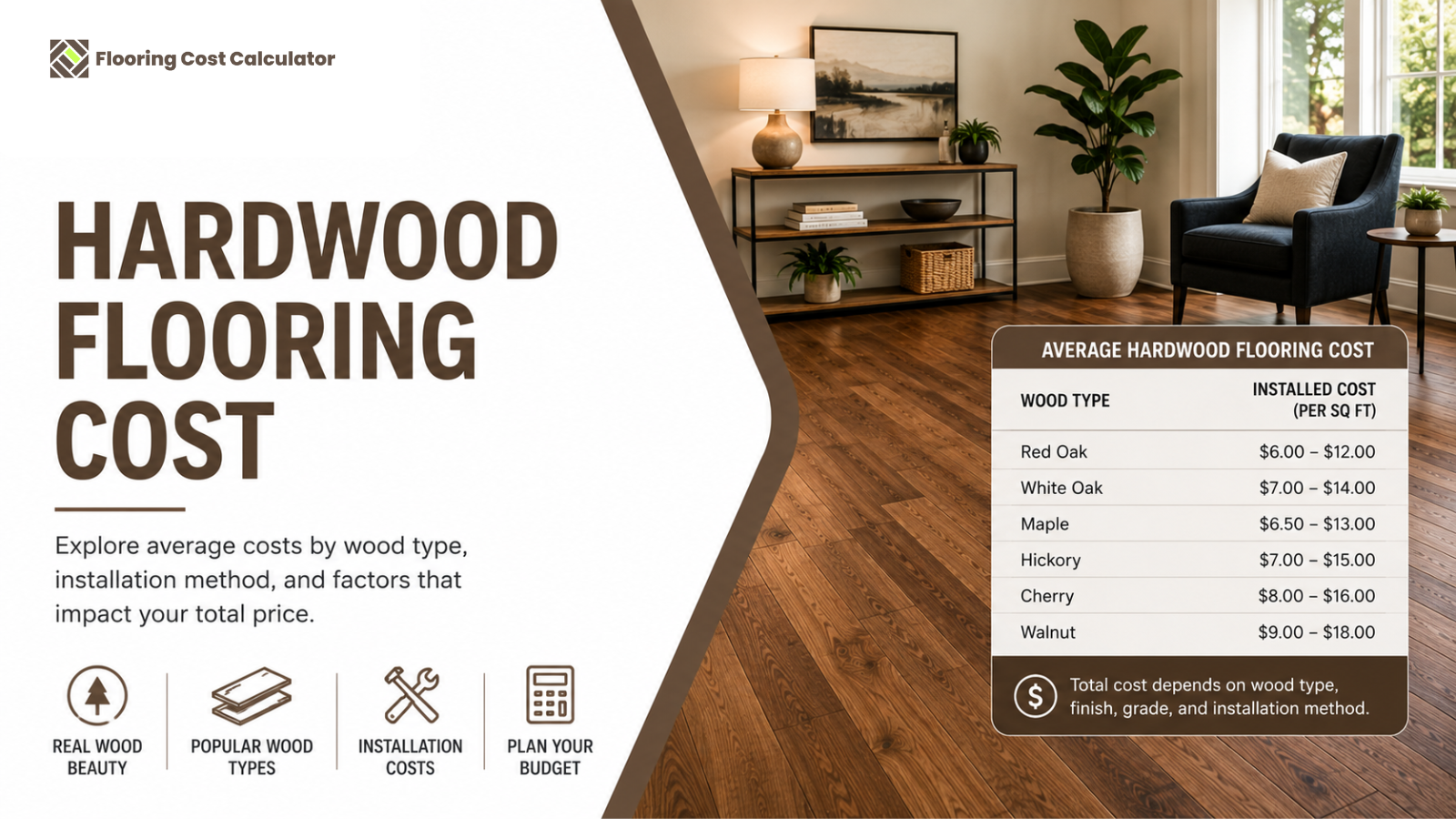
How Wood Species Affects Hardwood Flooring Cost
The species of wood is one of the most important factors affecting hardwood flooring prices.
Different species vary in:
- Availability
- Appearance
- Grain pattern
- Color
- Hardness
- Manufacturing cost
Common hardwood species include:
Oak
Oak is one of the most widely used hardwood flooring materials.
It is popular because of its:
- Classic appearance
- Distinctive grain
- Wide availability
- Variety of finishes
Red oak and white oak are both common flooring choices.
Maple
Maple typically has a smoother, more subtle grain pattern than oak.
It can provide a clean appearance that works well in both traditional and contemporary interiors.
Hickory
Hickory is known for its dramatic grain variation and distinctive natural character.
It is also a hard wood species, making it attractive to homeowners who prioritize durability.
Walnut
Walnut is valued for its rich, darker appearance and elegant grain patterns.
It is often considered a more premium flooring option and may cost more than commonly available species.
The specific species you select can significantly influence the material portion of your hardwood flooring budget.
Solid Hardwood vs. Engineered Hardwood Cost
Homeowners shopping for wood flooring will often encounter two major categories:
- Solid hardwood
- Engineered hardwood
Solid Hardwood
Solid hardwood planks are manufactured from a single piece of wood.
Depending on the product and thickness, solid hardwood may be refinished multiple times during its lifespan.
It is commonly installed using nails or staples.
Engineered Hardwood
Engineered hardwood is constructed using multiple layers with a real wood veneer on the surface.
Depending on the product, engineered hardwood may be installed using:
- Nails
- Staples
- Adhesive
- Floating systems
Pricing varies widely in both categories.
A premium engineered hardwood product can cost more than an entry-level solid hardwood product.
For this reason, homeowners should compare individual products rather than assuming one category is always cheaper.
How Hardwood Grade Affects Cost
Wood flooring is available in different grades that influence its appearance.
Depending on the manufacturer and grading system, higher grades may provide:
- More uniform color
- Fewer knots
- Fewer visible natural variations
Other grades may intentionally showcase:
- Knots
- Mineral streaks
- Color variation
- Natural character
The preferred grade is largely an aesthetic decision.
A rustic floor with visible character may be perfect for one home, while another homeowner may prefer a more uniform appearance.
Grade can also affect material pricing.
How Plank Width Affects Hardwood Cost
Hardwood flooring is available in many plank widths.
Traditional floors often use narrower boards.
Modern designs frequently feature wider planks.
Wide-plank flooring can create:
- A more open appearance
- Fewer visible seams
- A distinctive premium look
However, wider planks may cost more depending on the species and manufacturing process.
They may also have specific installation requirements.
If you are comparing hardwood products, make sure you are comparing similar plank dimensions.
Prefinished vs. Site-Finished Hardwood
Hardwood flooring can be purchased prefinished or finished after installation.
Prefinished Hardwood
Prefinished flooring arrives with the factory finish already applied.
Potential advantages include:
- Faster installation process
- No on-site finishing
- Predictable factory finish
Site-Finished Hardwood
Site-finished hardwood is installed unfinished and then sanded and finished in the home.
This approach may allow:
- Custom stain colors
- A more continuous finished surface
- Greater design flexibility
However, on-site sanding and finishing require additional labor and project time.
The choice between prefinished and site-finished flooring can therefore affect the total project cost.
Hardwood Installation Labor Cost
Professional labor represents an important part of the installed hardwood flooring price.
Hardwood installation may require specialized skills and tools.
Depending on the flooring and subfloor, installation methods may include:
- Nail-down
- Staple-down
- Glue-down
- Floating installation for certain engineered products
Labor costs can vary based on:
- Installation method
- Room layout
- Flooring dimensions
- Contractor experience
- Geographic location
Complex installations generally require more time and can increase the labor cost per square foot.
Nail-Down Hardwood Installation
Nail-down installation is commonly used for solid hardwood over suitable wood subfloors.
The flooring is mechanically fastened to the subfloor.
This method requires:
- Proper subfloor preparation
- Specialized installation equipment
- Careful plank placement
The condition of the subfloor can significantly affect the complexity of the installation.
Glue-Down Hardwood Installation
Some hardwood and engineered wood products are installed using adhesive.
Glue-down installation requires careful surface preparation.
The subfloor generally needs to be:
- Clean
- Stable
- Appropriately prepared
The cost of adhesive and additional labor should be considered when calculating the complete project price.
Existing Flooring Removal Cost
If you are replacing an existing floor, removal can add to your hardwood flooring budget.
Removal costs vary depending on the existing material.
Potential materials include:
- Carpet
- Laminate
- Vinyl
- Hardwood
- Tile
Carpet may be relatively straightforward to remove.
Tile can require significantly more demolition work.
Glued flooring may also be time-consuming to remove.
Ask your contractor whether demolition, hauling, and disposal are included in the installation estimate.
Subfloor Preparation Cost
Hardwood flooring requires a properly prepared foundation.
Potential subfloor problems include:
- Uneven areas
- Loose sections
- Squeaks
- Water damage
- Rot
- Structural movement
These problems may need to be corrected before hardwood is installed.
Some issues are visible before construction begins.
Others may not become apparent until the existing flooring is removed.
For this reason, homeowners replacing older floors may want to maintain a contingency in their project budget.
Floor Leveling Cost
An uneven subfloor can create problems for a new hardwood installation.
Depending on the situation, preparation may involve:
- Sanding or grinding high areas
- Filling low areas
- Repairing damaged sections
The amount of work required depends on the existing floor condition and the hardwood manufacturer's installation requirements.
Extensive leveling can increase the final installed cost.
Moisture Considerations
Wood naturally reacts to changes in moisture.
Proper installation practices are therefore particularly important for hardwood flooring.
Depending on the project, installers may need to consider:
- Subfloor moisture
- Indoor humidity
- Acclimation requirements
- Moisture barriers
Ignoring moisture conditions can contribute to flooring problems after installation.
Follow manufacturer recommendations and professional installation guidance.
How Much Extra Hardwood Should You Buy?
You generally need to purchase more hardwood than the exact measured floor area.
Additional flooring accounts for:
- Cuts
- Waste
- Damaged boards
- Layout requirements
- Future repairs
The appropriate amount depends on:
- Room shape
- Installation pattern
- Product
- Manufacturer recommendations
For example, a straightforward rectangular room may require less additional material than a complex layout with multiple angles and closets.
Decorative patterns can require even more material.
Confirm the appropriate waste allowance before ordering.
Hardwood Flooring Cost by State
Geographic location can significantly affect hardwood installation costs.
Based on the 2026 state-level pricing used by the Flooring Cost Calculator, some example ranges include:
Lower-Cost States
- Arkansas: $8–$14 per square foot
- Mississippi: $8–$14 per square foot
- Alabama: $8.50–$15 per square foot
- Kentucky: $8.75–$15.50 per square foot
- Oklahoma: $8.75–$15.50 per square foot
Mid-Range Examples
- Colorado: $10.50–$18 per square foot
- Illinois: $10.50–$18 per square foot
- Virginia: $10.50–$18 per square foot
- Minnesota: $11–$19 per square foot
- Pennsylvania: $11–$19 per square foot
Higher-Cost States
- Massachusetts: $13–$22.50 per square foot
- Washington: $13–$23 per square foot
- California: $14–$24 per square foot
- New York: $14–$24 per square foot
- Alaska: $15–$25 per square foot
- Hawaii: $17–$28 per square foot
These ranges demonstrate why location-specific pricing is useful when estimating a hardwood flooring project.
Example: Hardwood Flooring Cost in Texas
Based on the 2026 pricing data, estimated installed hardwood flooring in Texas ranges from:
$9.50–$16.50 per square foot
For a 500-square-foot project:
Low estimate:
500 × $9.50 = $4,750
High estimate:
500 × $16.50 = $8,250
Estimated project cost:
$4,750–$8,250
For a 1,000-square-foot project:
Low estimate:
1,000 × $9.50 = $9,500
High estimate:
1,000 × $16.50 = $16,500
Estimated project cost:
$9,500–$16,500
Additional project-specific expenses may apply.
Example: Hardwood Flooring Cost in California
California has a higher estimated range of:
$14–$24 per square foot
For 500 square feet:
$7,000–$12,000
For 1,000 square feet:
$14,000–$24,000
This demonstrates how geographic location can significantly affect the total investment required for a large hardwood flooring project.
How Room Layout Affects Hardwood Flooring Cost
A simple rectangular room is generally easier to install than a complex floor plan.
Features that may increase installation complexity include:
- Angled walls
- Closets
- Narrow hallways
- Multiple doorways
- Columns
- Built-in cabinetry
- Connected rooms
Complex layouts require more:
- Measuring
- Cutting
- Fitting
- Installation time
They can also increase material waste.
Hardwood Installation Patterns
The installation pattern can also affect cost.
A traditional straight plank layout is generally simpler than decorative patterns.
More complex options include:
- Herringbone
- Chevron
- Diagonal installation
- Decorative borders
These designs may require:
- Additional planning
- More cuts
- More flooring material
- Additional labor
If you are considering a decorative hardwood pattern, ask your installer how it will affect both material requirements and labor costs.
Hardwood Flooring on Stairs
Installing hardwood on stairs is generally priced differently from standard floor installation.
Each stair may require:
- Individual measurement
- Precise cutting
- Stair nosing
- Detailed fitting
Contractors may charge per step rather than using the standard square-foot installation rate.
If your flooring project includes a staircase, request a separate estimate for this portion of the work.
Baseboards and Trim
A hardwood flooring installation may affect existing baseboards and trim.
Your project may involve:
- Removing existing baseboards
- Reinstalling them
- Installing new baseboards
- Adding quarter round
- Adding shoe molding
These services may be charged separately.
Ask whether trim work is included in your contractor's estimate.
Transition Strips
Transitions may be required where hardwood meets other flooring materials.
Common examples include:
- Hardwood to carpet
- Hardwood to tile
- Hardwood to LVP
Transition materials and installation may add to the final project cost.
For homes with multiple flooring materials, count the number of transition areas when planning your budget.
Furniture and Appliance Moving
Rooms generally need to be cleared before hardwood installation begins.
Some contractors may move basic furniture.
Others may charge separately.
Large items such as:
- Beds
- Sofas
- Cabinets
- Refrigerators
- Washing machines
may require additional planning.
Clarify furniture and appliance responsibilities before the project begins.
Is Hardwood More Expensive Than LVP?
Based on the 2026 state-level pricing used by the Flooring Cost Calculator, hardwood generally has a higher installed cost than luxury vinyl plank.
LVP ranges approximately:
$5–$18 per square foot
Hardwood ranges approximately:
$8–$28 per square foot
However, cost is not the only difference.
Hardwood provides authentic natural wood and may offer refinishing potential.
LVP generally provides better moisture resistance and requires less routine maintenance.
The better option depends on your budget and priorities.
Is Hardwood More Expensive Than Laminate?
Yes, hardwood generally costs more than laminate.
Based on the state-level pricing data:
Laminate: approximately $4–$13 per square foot
Hardwood: approximately $8–$28 per square foot
Laminate may provide a practical alternative for homeowners who want a wood-look appearance at a lower initial cost.
However, laminate does not provide the same natural material or refinishing potential as genuine hardwood.
Does Hardwood Flooring Increase Home Value?
Hardwood is often considered a desirable flooring material because of its:
- Natural appearance
- Durability
- Timeless design
- Long potential lifespan
However, the effect of a flooring project on home value depends on many factors, including:
- Local housing market
- Home condition
- Flooring quality
- Installation quality
- Buyer preferences
Homeowners should generally choose flooring based on both personal enjoyment and practical long-term value rather than assuming that every dollar spent will be recovered at resale.
Hardwood Flooring Maintenance Costs
Hardwood requires regular care to maintain its appearance.
Routine maintenance may include:
- Sweeping
- Vacuuming
- Cleaning with appropriate products
- Protecting high-traffic areas
- Using furniture pads
Homeowners should also address spills promptly.
Over time, some hardwood floors may be refinished.
Refinishing can restore the surface and extend the useful life of suitable hardwood flooring, although the number of possible refinishing cycles depends on the flooring construction and thickness.
How to Save Money on Hardwood Flooring
There are several ways to manage hardwood flooring costs without compromising essential installation quality.
Consider:
- Comparing multiple contractor estimates
- Choosing a commonly available wood species
- Selecting a straightforward plank layout
- Clearing rooms before installation
- Moving smaller furniture yourself
- Completing multiple rooms during one project
- Purchasing flooring during promotions
However, avoid saving money by skipping necessary:
- Subfloor repairs
- Moisture testing
- Floor preparation
- Manufacturer-required installation materials
Proper preparation can help protect a significant hardwood flooring investment.
Questions to Ask a Hardwood Flooring Contractor
Before hiring an installer, ask:
- What installation method will be used?
- Is existing flooring removal included?
- Is disposal included?
- How will the subfloor be inspected?
- Is floor leveling included?
- Are moisture tests required?
- Does the flooring need to acclimate?
- How much additional material should I purchase?
- Are trim and transitions included?
- Are stairs priced separately?
- Is furniture moving included?
- What warranty is provided?
Clear answers can help prevent unexpected costs after installation begins.
Frequently Asked Questions
How much does hardwood flooring cost per square foot?
Based on the 2026 state-level pricing used by the Flooring Cost Calculator, estimated installed hardwood costs range from approximately $8–$28 per square foot.
Actual costs depend on location, product selection, installation requirements, and project conditions.
How much does it cost to install 500 square feet of hardwood?
Using the overall state-level range of $8–$28 per square foot, a 500-square-foot project could range from approximately $4,000 to $14,000.
A state-specific calculation provides a more useful estimate.
How much does it cost to install 1,000 square feet of hardwood?
Using the broad $8–$28 range, approximately $8,000–$28,000.
Actual costs depend heavily on location and flooring selection.
What affects hardwood flooring cost the most?
Major factors include wood species, product quality, geographic location, installation method, project size, subfloor condition, and room complexity.
Is engineered hardwood cheaper than solid hardwood?
Not always.
Both categories include budget and premium products.
A high-quality engineered hardwood can cost more than an entry-level solid hardwood product.
Does hardwood flooring installation include removal?
Not necessarily.
Ask whether existing flooring removal, hauling, and disposal are included in your estimate.
Do I need to buy extra hardwood?
Generally, yes.
Additional flooring is typically required for cuts, waste, and layout requirements.
Can hardwood flooring be refinished?
Many solid hardwood floors and some engineered hardwood products can be refinished.
The number of times depends on the product's construction and thickness.
Is hardwood worth the cost?
Hardwood can provide excellent long-term value for homeowners who prioritize authentic natural materials, appearance, longevity, and potential refinishing.
Whether it is the best choice depends on your budget and the needs of the room.
Final Verdict
Hardwood flooring is generally one of the more expensive residential flooring choices, but it also offers authentic natural beauty, long-term durability, and potential refinishing that alternative flooring materials cannot fully replicate.
Based on the 2026 state-level pricing used by the Flooring Cost Calculator, estimated installed hardwood flooring costs range from approximately $8 to $28 per square foot.
Location can make a significant difference. Arkansas and Mississippi are at the lower end of the pricing data at approximately $8–$14 per square foot, while Hawaii reaches approximately $17–$28 per square foot.
The final cost of your project will depend on much more than geographic location.
Wood species, grade, plank dimensions, installation method, room complexity, existing flooring removal, and subfloor condition can all influence the total investment.
For the most accurate budget, calculate the complete project rather than focusing exclusively on the retail price of the hardwood.
Final Thoughts
Hardwood flooring can be a significant investment, making careful budgeting particularly important.
Begin by measuring your installation area and selecting the type of hardwood that best fits your home's design and practical requirements. Consider the species, plank width, finish, and whether solid or engineered hardwood is more appropriate for your project.
Next, estimate the installed cost using pricing appropriate for your state.
Remember to account for potential additional expenses such as existing flooring removal, disposal, subfloor repairs, floor leveling, installation materials, trim, transitions, and stairs.
When comparing contractors, request itemized estimates so you can understand exactly what each price includes. The lowest quote may not necessarily represent the lowest complete project cost if important services are excluded.
Before requesting contractor estimates, use the Flooring Cost Calculator on the homepage to estimate your hardwood flooring cost based on your room size and state. A personalized estimate can help you establish a realistic 2026 budget, understand local hardwood installation prices, and compare contractor quotes with greater confidence.