 Flooring Cost Calculator
Introduction
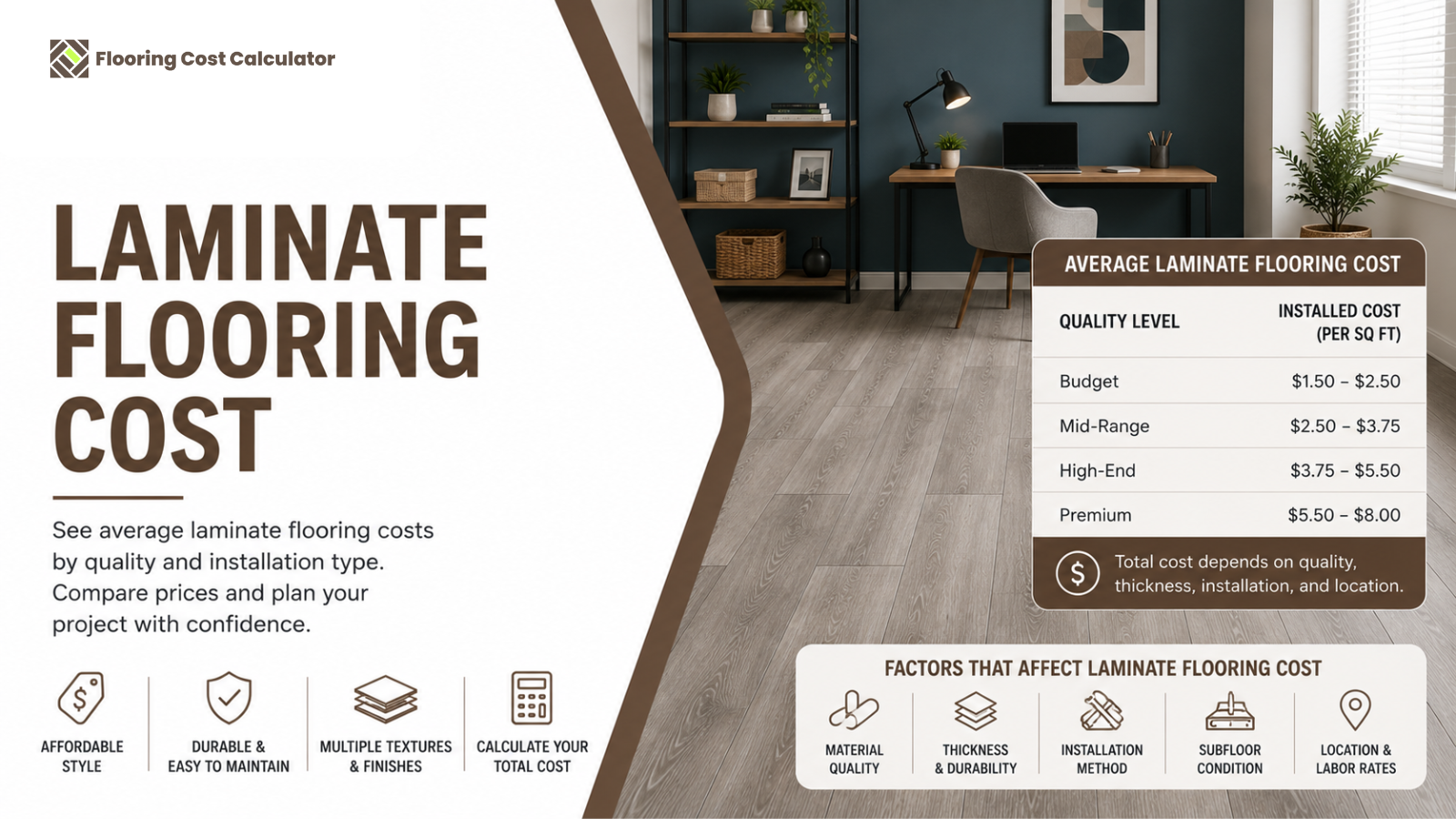
Laminate flooring is a popular choice for homeowners who want the appearance of natural wood without the higher cost associated with traditional hardwood. Modern laminate products are available in a wide variety of colors, textures, plank sizes, and realistic wood-look designs, making them suitable for many interior styles and budgets.
For homeowners planning a flooring replacement, laminate can provide an attractive balance between affordability, durability, and relatively simple maintenance. However, the price of the laminate flooring itself represents only one part of the potential project cost.
A complete laminate flooring installation may also involve professional labor, additional flooring for cuts and waste, removal and disposal of existing flooring, subfloor preparation, floor leveling, underlayment, moisture protection, baseboards, trim, transitions, and other project-specific expenses.
Geographic location can also significantly influence the final price.
Based on the 2026 state-level pricing used by the Flooring Cost Calculator, estimated installed laminate flooring costs range from approximately $4 to $13 per square foot, depending on the state.
At the lower end of the pricing data, homeowners in states such as Arkansas and Mississippi may encounter estimated installed costs of approximately $4–$6.50 per square foot. At the higher end, Hawaii reaches an estimated $8–$13 per square foot.
The actual amount you pay will depend on your location, the laminate product you select, the installation method, the size and complexity of the project, and the condition of the existing floor.
This guide explains laminate flooring costs, the factors that influence pricing, and the additional expenses homeowners should consider when budgeting for a new laminate floor.
Quick Answer
Based on the 2026 state-level pricing used by the Flooring Cost Calculator, estimated installed laminate flooring costs range from approximately:
$4–$13 per square foot
At the lower end of the state-level data:
- Arkansas: $4–$6.50 per square foot
- Mississippi: $4–$6.50 per square foot
- Alabama: $4–$7 per square foot
- Kentucky: $4.25–$7.25 per square foot
- Oklahoma: $4.25–$7.25 per square foot
At the higher end:
- Hawaii: $8–$13 per square foot
- Alaska: $7–$12 per square foot
- California: $6.50–$11 per square foot
- New York: $6.50–$11 per square foot
- Massachusetts: $6.25–$10.50 per square foot
Actual project costs may vary depending on local labor rates, flooring quality, installation requirements, and additional preparation work.
What Is Laminate Flooring?
Laminate is a manufactured flooring product designed to reproduce the appearance of natural materials, most commonly hardwood.
Rather than being constructed from solid wood, laminate typically consists of multiple layers engineered to work together.
Depending on the product, these may include:
- A structural core
- A decorative image layer
- A protective wear layer
- A backing or balancing layer
The decorative layer allows manufacturers to create flooring that resembles many different wood species and finishes.
Popular laminate styles may reproduce the appearance of:
- Oak
- Walnut
- Maple
- Hickory
- Pine
- Reclaimed wood
Modern manufacturing techniques can also add surface textures designed to make the flooring look and feel more realistic.
Because laminate is manufactured rather than cut directly from natural hardwood, it can generally provide a wood-look appearance at a lower initial cost.
What Is Included in Laminate Flooring Cost?
When researching laminate flooring prices, it is important to determine exactly what a quoted price includes.
A complete laminate flooring project may involve:
- Laminate flooring material
- Professional installation
- Additional material for cuts and waste
- Existing flooring removal
- Disposal
- Subfloor preparation
- Floor leveling
- Underlayment
- Moisture barriers
- Baseboards
- Quarter round or shoe molding
- Transition strips
- Stair installation
Not every project requires all of these expenses.
However, focusing only on the retail price of the laminate can lead homeowners to underestimate the complete cost of replacing their floors.
Always determine whether the price you are considering represents material-only pricing or an installed cost.
Laminate Material Cost vs. Installed Cost
Understanding the difference between material cost and installed cost is essential when comparing laminate flooring prices.
Material Cost
Material cost generally represents only the laminate flooring product.
The price may vary based on:
- Product quality
- Thickness
- Wear resistance
- Water resistance
- Surface texture
- Plank dimensions
- Attached backing
- Brand
A retailer may advertise laminate at an attractive price per square foot, but that does not necessarily represent the amount you will pay for the complete project.
Installed Cost
Installed cost generally includes the laminate material and professional installation labor.
Depending on the contractor or retailer, it may also include some basic installation materials.
However, additional charges may still apply for:
- Existing flooring removal
- Disposal
- Subfloor repairs
- Floor leveling
- Underlayment
- Moisture protection
- Trim
- Transitions
- Stairs
When comparing estimates, ask for an itemized breakdown of the work included.
Laminate Flooring Cost Per Square Foot
Based on the 2026 state-level pricing used by the Flooring Cost Calculator, estimated installed laminate flooring costs range from approximately:
$4–$13 per square foot
The wide range reflects differences in both regional pricing and project requirements.
A straightforward laminate installation using a standard product in a lower-cost market may fall toward the lower end.
A higher-quality laminate installation in a more expensive location may approach the upper end.
Your actual cost per square foot may also increase if the project requires significant demolition or subfloor preparation.
Laminate Flooring Cost by Project Size
Once you know your estimated installed price per square foot, you can calculate a preliminary budget.
The basic formula is:
Project Square Footage × Cost Per Square Foot = Estimated Project Cost
Using the broad state-level range of $4–$13 per square foot, potential project costs are as follows.
200 Square Feet
At $4 per square foot:
200 × $4 = $800
At $13 per square foot:
200 × $13 = $2,600
Estimated range:
$800–$2,600
500 Square Feet
At $4 per square foot:
500 × $4 = $2,000
At $13 per square foot:
500 × $13 = $6,500
Estimated range:
$2,000–$6,500
1,000 Square Feet
At $4 per square foot:
1,000 × $4 = $4,000
At $13 per square foot:
1,000 × $13 = $13,000
Estimated range:
$4,000–$13,000
1,500 Square Feet
At $4 per square foot:
1,500 × $4 = $6,000
At $13 per square foot:
1,500 × $13 = $19,500
Estimated range:
$6,000–$19,500
These calculations use the complete low-to-high range across all states.
For a more useful preliminary estimate, use the laminate flooring cost range associated with your specific state.
What Factors Affect Laminate Flooring Cost?
Several factors determine the final cost of installing laminate flooring.
Some relate to the product itself, while others relate to the condition and complexity of your home.
Important factors include:
- Laminate quality
- Product thickness
- Wear resistance
- Water resistance
- Plank size
- Installation method
- Project size
- Geographic location
- Existing flooring removal
- Subfloor condition
- Floor leveling
- Underlayment
- Room complexity
Understanding these factors can help homeowners compare flooring products and contractor estimates more accurately.
How Laminate Quality Affects Cost
Laminate flooring is available across a broad range of quality levels.
Lower-cost products may provide a basic wood-look design suitable for certain residential applications.
Premium products may offer improvements such as:
- More realistic surface textures
- Greater design detail
- Improved wear resistance
- Enhanced moisture resistance
- More substantial construction
Higher-quality laminate generally costs more per square foot.
However, the cheapest product is not necessarily the best value.
Consider the amount of foot traffic and daily use the flooring will experience before choosing a product based exclusively on price.
How Laminate Thickness Affects Price
Laminate flooring is manufactured in different thicknesses.
Thicker flooring may provide differences in:
- Underfoot feel
- Sound characteristics
- Installation performance
However, thickness alone does not determine overall product quality.
A homeowner comparing laminate products should also consider:
- Wear rating
- Moisture performance
- Core construction
- Surface quality
- Manufacturer specifications
A thicker product is not automatically superior to every thinner alternative.
Wear Resistance and Laminate Cost
Laminate floors are designed to withstand everyday foot traffic, but different products are intended for different levels of use.
A bedroom may have relatively light traffic.
A hallway or living area may experience much heavier daily use.
Products designed for higher traffic levels may cost more, but choosing an appropriate product for the installation area can help improve long-term performance.
Before purchasing laminate, review the manufacturer's recommendations for intended use.
Water-Resistant Laminate Cost
Traditional laminate has generally been more vulnerable to moisture than materials such as luxury vinyl plank.
However, many newer laminate products are marketed with improved water resistance.
These products may cost more than basic laminate.
It is important to understand the difference between terms such as:
- Water-resistant
- Waterproof
Marketing terminology and performance specifications can vary between manufacturers.
Homeowners should review the specific product's installation and maintenance requirements rather than assuming every laminate floor performs the same way around moisture.
Click-Lock Laminate Installation
Most modern residential laminate uses a click-lock installation system.
The planks connect to one another and are generally installed as a floating floor.
This means the flooring typically rests over the subfloor or underlayment rather than being permanently attached across the entire surface.
Click-lock systems can make laminate relatively efficient to install.
However, the subfloor still needs to meet manufacturer requirements.
A floating installation does not eliminate the need for proper floor preparation.
Professional Laminate Installation Labor
Professional installation represents an important part of the total laminate flooring cost.
Labor rates depend on:
- Geographic location
- Project size
- Room layout
- Contractor experience
- Subfloor condition
A large rectangular room may be relatively straightforward to install.
A project involving multiple rooms, closets, hallways, and doorways may require significantly more measuring and cutting.
Complex projects can therefore have higher installation costs even when the total square footage is similar.
Existing Flooring Removal Cost
Before laminate flooring can be installed, the existing flooring may need to be removed.
Potential materials include:
- Carpet
- Old laminate
- Vinyl
- Hardwood
- Tile
Removal difficulty varies considerably.
Carpet may be relatively straightforward to remove.
Tile can require much more labor because contractors may need to:
- Break the tile
- Remove mortar
- Clean the surface
- Prepare the substrate
Glued-down flooring can also be time-consuming.
Ask whether removal is included in the installation price.
Flooring Disposal Cost
Removing old flooring creates debris that needs to be handled and disposed of.
Disposal expenses may include:
- Loading
- Hauling
- Disposal fees
Some flooring contractors include disposal in the demolition price.
Others charge separately.
Before comparing contractor estimates, determine whether both removal and disposal are included.
Subfloor Preparation Cost
A properly prepared subfloor is essential for a successful laminate installation.
The surface generally needs to be:
- Clean
- Dry
- Stable
- Appropriately level
Potential subfloor problems include:
- Uneven areas
- Cracks
- Loose sections
- Water damage
- Rot
- Structural movement
Some issues may not become visible until the existing flooring is removed.
If extensive repairs are necessary, the total project cost can increase significantly.
Floor Leveling Cost
Floating laminate flooring still requires an appropriately level surface.
An uneven subfloor can potentially contribute to:
- Movement
- Noise
- Stress on locking joints
- Poor overall performance
Depending on the condition of the floor, preparation may involve:
- Grinding high areas
- Filling low areas
- Applying leveling materials
Minor preparation may have little effect on the total budget.
Extensive leveling can add considerably to the final cost.
Does Laminate Flooring Require Underlayment?
Many laminate installations require underlayment.
Depending on the product and installation, underlayment may help provide:
- Sound reduction
- Cushioning
- Moisture protection
- Separation between the laminate and subfloor
Some laminate products come with attached underlayment.
Others require a separate product.
Always follow manufacturer specifications.
If separate underlayment is required, remember to include both the material and installation in your flooring budget.
Moisture Barrier Costs
Certain laminate installations may require additional moisture protection.
This can be particularly important when installing over concrete.
Requirements depend on:
- Subfloor type
- Flooring product
- Manufacturer instructions
A moisture barrier may represent a relatively small portion of the overall flooring budget, but it should not be ignored when required.
Proper moisture management can help protect the flooring system.
How Much Extra Laminate Should You Buy?
Homeowners generally need to purchase more laminate than the exact measured floor area.
Additional material accounts for:
- Cuts
- Waste
- Damaged planks
- Layout requirements
For example, a 500-square-foot installation will typically require more than exactly 500 square feet of laminate.
The appropriate amount depends on:
- Room shape
- Number of rooms
- Plank dimensions
- Installation pattern
Complex layouts generally produce more waste than straightforward rectangular rooms.
Manufacturer recommendations and your installer's advice can help determine the appropriate quantity.
How Room Layout Affects Laminate Cost
Two homes with identical flooring square footage may have different installation costs.
A single large rectangular space is generally simpler than a project containing:
- Multiple bedrooms
- Closets
- Narrow hallways
- Angled walls
- Doorways
- Built-in cabinets
- Columns
Complex layouts require more:
- Measuring
- Cutting
- Fitting
They can also result in greater material waste.
This additional labor can increase the effective cost per square foot.
Installation Pattern and Laminate Cost
A traditional straight plank layout is generally the simplest installation pattern.
Some projects may use alternative layouts depending on the flooring product.
More complex patterns can require:
- Additional planning
- More cuts
- More flooring material
- Additional installation time
Not every laminate product is designed for decorative installation patterns.
Always verify product compatibility before selecting a specialized layout.
Laminate Flooring Cost by State
Geographic location can have a substantial impact on laminate installation prices.
Based on the 2026 state-level pricing used by the Flooring Cost Calculator, example ranges include:
Lower-Cost States
- Arkansas: $4–$6.50 per square foot
- Mississippi: $4–$6.50 per square foot
- Alabama: $4–$7 per square foot
- Kentucky: $4.25–$7.25 per square foot
- Oklahoma: $4.25–$7.25 per square foot
Mid-Range Examples
- Colorado: $5–$8.50 per square foot
- Illinois: $5–$8.50 per square foot
- Michigan: $5–$8.50 per square foot
- Virginia: $5–$8.50 per square foot
- Pennsylvania: $5.25–$9 per square foot
Higher-Cost States
- New Jersey: $6–$10.50 per square foot
- District of Columbia: $6–$10.50 per square foot
- Washington: $6–$10.50 per square foot
- Massachusetts: $6.25–$10.50 per square foot
- California: $6.50–$11 per square foot
- New York: $6.50–$11 per square foot
- Alaska: $7–$12 per square foot
- Hawaii: $8–$13 per square foot
These differences illustrate why homeowners should consider local pricing rather than relying exclusively on a single national average.
Example: Laminate Flooring Cost in Texas
Based on the 2026 state-level pricing, estimated installed laminate flooring costs in Texas range from:
$4.50–$8 per square foot
For a 500-square-foot project:
Low estimate:
500 × $4.50 = $2,250
High estimate:
500 × $8 = $4,000
Estimated project cost:
$2,250–$4,000
For a 1,000-square-foot project:
Low estimate:
1,000 × $4.50 = $4,500
High estimate:
1,000 × $8 = $8,000
Estimated project cost:
$4,500–$8,000
Additional expenses may apply depending on project conditions.
Example: Laminate Flooring Cost in California
California has an estimated installed laminate flooring range of:
$6.50–$11 per square foot
For 500 square feet:
$3,250–$5,500
For 1,000 square feet:
$6,500–$11,000
Compared with Texas, a similar project may therefore have a higher preliminary cost based on the state-level pricing data.
Example: Laminate Flooring Cost in Hawaii
Hawaii has the highest estimated laminate flooring range in the pricing data:
$8–$13 per square foot
For 500 square feet:
$4,000–$6,500
For 1,000 square feet:
$8,000–$13,000
This demonstrates how regional pricing differences become increasingly significant as project size increases.
Laminate Flooring on Stairs
Installing laminate on stairs generally requires more detailed work than installing flooring across a flat room.
Each stair may require:
- Individual measurements
- Precise cuts
- Stair nosing
- Specialized trim
Contractors may price stairs individually rather than using the standard per-square-foot installation rate.
If your flooring project includes stairs, request a separate estimate.
Baseboards and Trim
Installing new laminate may affect existing baseboards and trim.
Depending on the project, you may need to budget for:
- Baseboard removal
- Baseboard reinstallation
- New baseboards
- Quarter round
- Shoe molding
Some contractors include basic trim work.
Others charge separately.
Ask exactly what is included in the installation price.
Transition Strips
Transitions are commonly required where laminate meets another flooring material.
Examples include:
- Laminate to carpet
- Laminate to tile
- Laminate to hardwood
- Laminate to LVP
Transitions may also be necessary between rooms depending on the flooring system and manufacturer installation requirements.
Include transition materials and labor in your overall project budget.
Furniture and Appliance Moving
Rooms typically need to be cleared before laminate installation begins.
Some contractors include basic furniture moving.
Others may charge additional fees.
Homeowners may be able to reduce costs by moving smaller items themselves before installation day.
Large appliances may require special arrangements.
Clarify responsibilities before the project begins to avoid delays.
Laminate vs. LVP Cost
Laminate and luxury vinyl plank are frequently compared because both can reproduce the appearance of natural wood.
Based on the 2026 state-level pricing used by the Flooring Cost Calculator:
Laminate: approximately $4–$13 per square foot installed
LVP: approximately $5–$18 per square foot installed
Laminate generally has a lower estimated installed cost.
LVP, however, often provides stronger moisture resistance.
The better choice depends on:
- Room location
- Moisture exposure
- Budget
- Design preferences
- Maintenance priorities
Laminate vs. Hardwood Cost
Hardwood generally requires a significantly larger investment than laminate.
Based on the state-level pricing:
Laminate: approximately $4–$13 per square foot
Hardwood: approximately $8–$28 per square foot
Laminate can provide a wood-look appearance at a lower initial price.
Hardwood provides authentic natural material and may offer refinishing potential.
Homeowners should consider both initial cost and long-term priorities when comparing the two materials.
Is Laminate Flooring Worth the Cost?
Laminate can provide strong value for homeowners seeking:
- Affordable wood-look flooring
- Wide design selection
- Relatively easy maintenance
- Efficient installation
Modern laminate products can provide convincing wood visuals at a fraction of the potential cost of premium hardwood.
However, product selection matters.
Homeowners should choose laminate appropriate for the expected:
- Foot traffic
- Moisture exposure
- Room use
The cheapest laminate product may not always provide the best long-term value for a busy household.
How Long Does Laminate Flooring Last?
The lifespan of laminate flooring varies depending on:
- Product quality
- Installation quality
- Foot traffic
- Moisture exposure
- Maintenance
A properly selected and installed laminate floor can provide many years of use.
However, unlike traditional solid hardwood, laminate generally cannot be sanded and refinished.
Once the wear layer or decorative surface is significantly damaged, replacement may be necessary.
Manufacturer warranties can provide useful information when comparing products.
Laminate Flooring Maintenance Costs
Routine laminate maintenance is generally straightforward.
Typical care may include:
- Sweeping
- Vacuuming
- Damp cleaning with approved products
- Cleaning spills promptly
Avoid allowing excessive water to remain on the floor unless the specific product is designed for such exposure.
Furniture pads may help reduce scratches and surface damage.
Always follow the manufacturer's cleaning recommendations.
Can Laminate Flooring Increase Home Value?
New flooring can improve the appearance and presentation of a home.
However, the effect of laminate flooring on resale value depends on factors such as:
- Overall home condition
- Flooring quality
- Installation quality
- Local housing market
- Buyer preferences
Laminate may not carry the same premium perception as genuine hardwood, but attractive, well-installed flooring can still improve the overall impression of a property.
Homeowners should generally choose flooring based on practical needs and budget rather than assuming the complete installation cost will automatically be recovered at resale.
How to Save Money on Laminate Flooring
There are several ways homeowners may be able to control laminate installation costs.
Consider:
- Comparing multiple contractor estimates
- Choosing a product appropriate for your needs
- Selecting a straightforward installation pattern
- Clearing rooms before installation
- Moving smaller furniture yourself
- Completing several rooms during one project
- Purchasing flooring during promotions
However, avoid reducing costs by skipping necessary:
- Subfloor repairs
- Floor leveling
- Moisture protection
- Required underlayment
Proper preparation can help prevent problems that may ultimately be more expensive to correct.
Questions to Ask a Laminate Flooring Contractor
Before hiring an installer, consider asking:
- Is the quoted price material-only or installed?
- Is existing flooring removal included?
- Is disposal included?
- Does the subfloor require repairs?
- Is floor leveling included?
- Does the laminate require underlayment?
- Is moisture protection required?
- How much extra flooring should I purchase?
- Are trim and transitions included?
- Are stairs priced separately?
- Is furniture moving included?
- What warranty is provided?
Getting clear answers before work begins can help prevent unexpected expenses.
Frequently Asked Questions
How much does laminate flooring cost per square foot?
Based on the 2026 state-level pricing used by the Flooring Cost Calculator, estimated installed laminate flooring costs range from approximately $4–$13 per square foot.
Actual costs depend on location, product quality, installation requirements, and project conditions.
How much does it cost to install 500 square feet of laminate?
Using the broad $4–$13 state-level range, a 500-square-foot project could cost approximately $2,000–$6,500.
Your state's specific pricing range will provide a more useful estimate.
How much does it cost to install 1,000 square feet of laminate?
Using the broad $4–$13 range, approximately $4,000–$13,000.
Actual costs depend heavily on location and project requirements.
What affects laminate flooring cost?
Major factors include product quality, geographic location, installation labor, existing flooring removal, subfloor condition, underlayment, room complexity, and installation pattern.
Is laminate cheaper than LVP?
Based on the 2026 state-level pricing used by the Flooring Cost Calculator, laminate generally has a lower estimated installed cost than luxury vinyl plank.
Is laminate cheaper than hardwood?
Yes.
The state-level data used by the Flooring Cost Calculator places laminate at approximately $4–$13 per square foot and hardwood at approximately $8–$28 per square foot installed.
Does laminate require underlayment?
Many laminate products require underlayment, while some include attached backing.
Always follow manufacturer specifications.
Can laminate be installed over existing flooring?
In some situations, yes.
The existing surface must generally meet the flooring manufacturer's requirements and be clean, stable, dry, and appropriately level.
Is laminate waterproof?
Some modern products are marketed with enhanced water resistance or waterproof performance. Specifications vary considerably, so review the manufacturer's instructions and limitations for the specific product.
Does laminate installation include flooring removal?
Not necessarily.
Ask whether removal, hauling, and disposal are included in your contractor's estimate.
Final Verdict
Laminate flooring is one of the more affordable ways to achieve a wood-look floor without the higher initial investment typically associated with genuine hardwood.
Based on the 2026 state-level pricing used by the Flooring Cost Calculator, estimated installed laminate flooring costs range from approximately $4 to $13 per square foot.
Geographic location can make a substantial difference.
Arkansas and Mississippi are at the lower end of the pricing data at approximately $4–$6.50 per square foot, while Hawaii reaches approximately $8–$13 per square foot.
However, location is only one factor.
The quality of the laminate, installation requirements, project size, existing flooring, subfloor condition, underlayment, room complexity, stairs, and trim can all affect the final project price.
For a realistic budget, homeowners should focus on the complete installed project cost rather than the advertised material price alone.
Final Thoughts
Laminate flooring can be an attractive choice for homeowners who want affordable, low-maintenance flooring with the appearance of natural wood.
Modern products offer a wide range of styles and performance characteristics, allowing homeowners to choose flooring suited to different rooms and budgets.
Before purchasing laminate, carefully measure the installation area and determine how much additional flooring you will need for cuts and waste. Then use the estimated installed cost for your state to create a preliminary project budget.
Remember to account for potential additional expenses such as existing flooring removal, disposal, subfloor preparation, floor leveling, underlayment, moisture protection, trim, transitions, and stairs.
When requesting professional estimates, ask contractors to provide an itemized breakdown of the project. This makes it easier to compare the complete scope of work rather than focusing exclusively on the lowest price per square foot.
Before requesting contractor estimates, use the Flooring Cost Calculator on the homepage to estimate your laminate flooring cost based on your room size and state. A personalized estimate can help you establish a realistic 2026 budget, understand local laminate installation prices, and compare contractor quotes with greater confidence.