 Flooring Cost Calculator
Introduction
Flooring is one of the most heavily used surfaces in any home. Every day, it is exposed to foot traffic, furniture, pets, spills, moisture, dirt, and general wear. Although quality flooring can last for decades, no material lasts forever.
Knowing when to repair flooring and when to replace it can help homeowners avoid unnecessary expenses while preventing small problems from becoming more serious. Minor scratches, isolated stains, or a single damaged plank may be repairable. However, widespread damage, persistent moisture problems, structural concerns, or significant wear may indicate that replacement is the better long-term solution.
The expected lifespan of a floor depends on many factors, including the material, installation quality, maintenance routine, household activity, and environmental conditions. Hardwood may remain attractive for generations when properly maintained, while carpet generally requires replacement much sooner. Luxury vinyl plank, laminate, and tile each have their own expected service lives and common signs of deterioration.
This guide explains the most common signs that it may be time to replace your flooring, how different materials age, and what homeowners should consider when deciding between repair and complete replacement.
Quick Answer
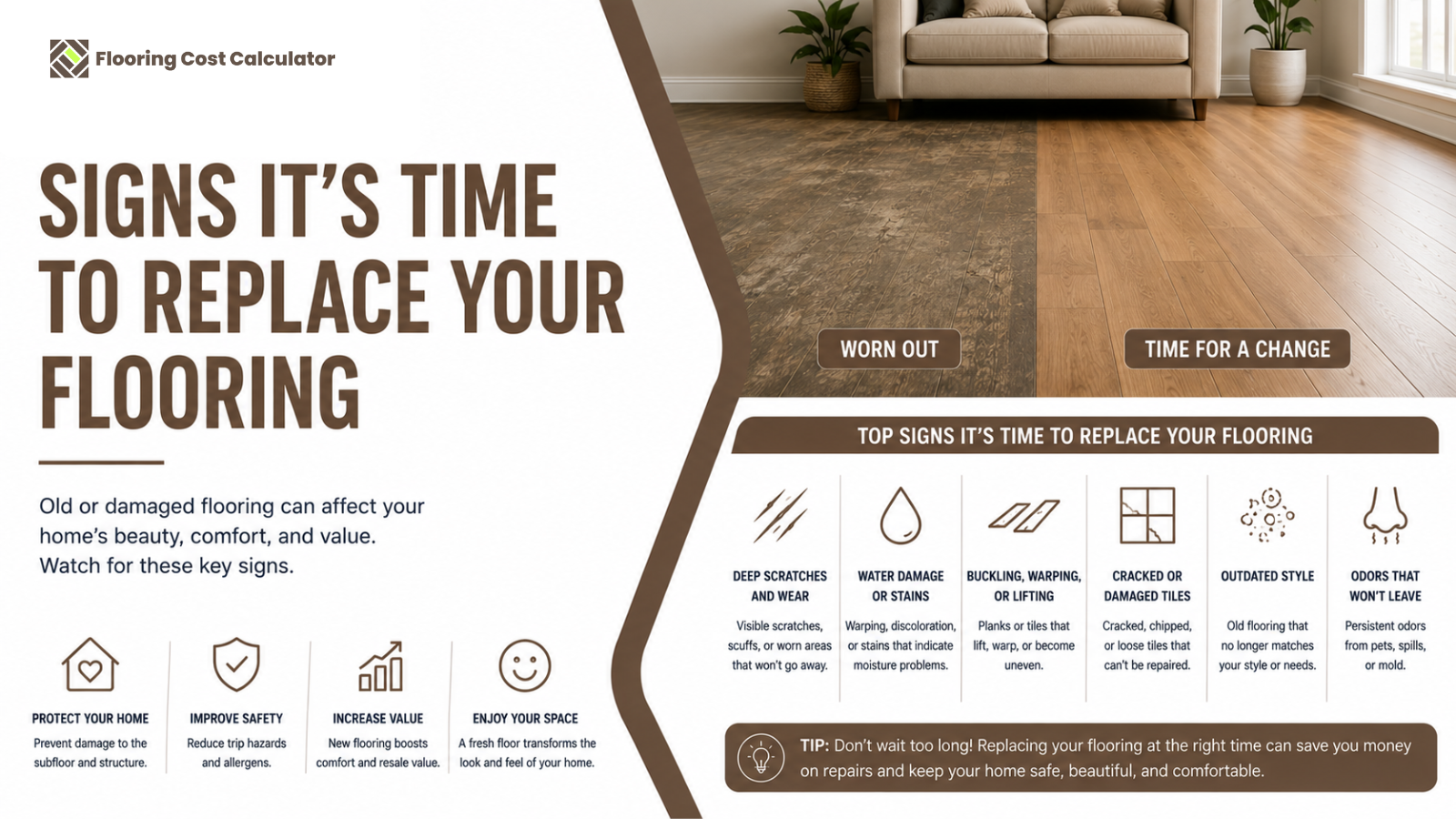
It may be time to replace your flooring if you notice:
- Widespread scratches or surface wear.
- Large areas of discoloration or staining.
- Cracked, broken, or loose flooring.
- Warping, buckling, or lifting.
- Persistent squeaking or movement.
- Significant water or moisture damage.
- Mold or mildew beneath the flooring.
- Carpet that remains stained or matted after cleaning.
- Flooring that has become difficult to maintain.
- Extensive damage that would be expensive to repair.
- An outdated appearance that affects your home's overall appeal.
The decision to replace flooring should be based on its overall condition, safety, performance, and repairability rather than age alone.
Your Flooring Has Widespread Visible Damage
One of the clearest signs that flooring may need replacement is extensive visible damage.
Depending on the material, this can include:
- Deep scratches
- Cracks
- Chips
- Dents
- Torn carpet
- Broken tiles
- Peeling surfaces
- Worn finishes
- Damaged plank edges
A small amount of localized damage does not necessarily justify replacing an entire floor. Individual planks, tiles, or carpet sections may sometimes be repaired or replaced.
However, when damage appears throughout a large portion of the room, repairing individual areas may become impractical.
At that point, replacement can provide a more consistent appearance and potentially better long-term value.
The Floor Is Severely Scratched
Minor surface scratches are common, especially in busy households with children or pets.
The seriousness of scratching depends partly on the flooring material.
Hardwood floors, for example, may sometimes be sanded and refinished if the damage is primarily limited to the surface.
Luxury vinyl plank and laminate are different. Because their decorative surfaces generally cannot be refinished in the same way as solid hardwood, deeply damaged planks may need to be replaced.
Consider replacement when:
- Scratches cover large areas.
- The protective wear layer is significantly damaged.
- Multiple planks are affected.
- Repairs would create noticeable color differences.
- The flooring has already reached an advanced stage of wear.
Before replacing hardwood, ask a flooring professional whether refinishing could restore the surface.
You Notice Warping or Buckling
Warping and buckling are more serious than ordinary cosmetic wear.
Flooring may begin to:
- Lift from the subfloor.
- Develop raised areas.
- Curve at the edges.
- Separate between planks.
- Create uneven walking surfaces.
These problems can occur for several reasons, including:
- Excessive moisture
- Water leaks
- Flooding
- Improper installation
- Insufficient expansion space
- Subfloor movement
Replacing the visible flooring without addressing the underlying cause may result in the same problem occurring again.
If you notice significant warping or buckling, investigate the source before installing new flooring.
Moisture problems, plumbing leaks, drainage issues, or subfloor damage should be corrected first.
Your Flooring Has Water Damage
Water can cause serious damage to many flooring materials.
Common sources include:
- Plumbing leaks
- Appliance leaks
- Flooding
- Roof leaks
- Foundation moisture
- Repeated spills
- High indoor humidity
Signs of water damage may include:
- Swelling
- Warping
- Discoloration
- Soft areas
- Loose flooring
- Peeling
- Musty odors
The extent of the damage determines whether repair or replacement is appropriate.
A small leak discovered quickly may only affect a limited area. However, prolonged water exposure can damage both the flooring and the subfloor beneath it.
Before replacing water-damaged flooring, the moisture source should be identified and corrected.
You Suspect Mold or Mildew
Persistent moisture beneath flooring can sometimes contribute to mold or mildew growth.
Potential warning signs include:
- Musty odors
- Visible discoloration
- Recurring moisture
- Flooring that remains damp
- Water damage beneath appliances or fixtures
Mold concerns should be evaluated carefully, particularly when moisture has reached the subfloor or other building materials.
Simply installing new flooring over an unresolved moisture problem is not an appropriate solution.
The source of moisture should be corrected and affected materials evaluated before replacement flooring is installed.
Tiles Are Cracked or Broken
A single cracked tile can often be replaced without disturbing the rest of the floor.
However, widespread cracking may indicate a larger problem.
Potential causes include:
- Subfloor movement
- Improper installation
- Impact damage
- Structural movement
- Inadequate preparation beneath the tile
If cracks repeatedly appear after repairs, replacing individual tiles may not solve the underlying issue.
A flooring professional may need to inspect the substrate before recommending replacement.
Extensive cracking can also create sharp edges or uneven surfaces, making replacement more important from a safety perspective.
Flooring Is Loose or Moving
Your flooring should generally feel stable underfoot.
If planks, tiles, or sections of flooring move when you walk across them, there may be a problem with:
- Adhesive
- Fasteners
- Subfloor preparation
- Locking systems
- Moisture
- Installation quality
Localized movement may be repairable.
Widespread movement, however, can indicate that a significant portion of the installation is failing.
In these situations, removing the existing floor may be necessary to properly inspect and prepare the surface underneath.
The Floor Has Become Uneven
An uneven floor may indicate more than ordinary wear.
Possible causes include:
- Subfloor damage
- Moisture problems
- Foundation movement
- Poor installation
- Settling
- Inadequate floor preparation
Signs may include:
- Low spots
- Raised areas
- Sloping
- Movement
- Cracked flooring
- Uneven transitions
Before replacing flooring, determine why the surface became uneven.
Installing new material directly over an unstable or irregular surface can lead to premature failure of the replacement floor.
Your Carpet Is Permanently Stained
Professional cleaning can dramatically improve many carpets, but some stains eventually become permanent.
Common difficult stains may result from:
- Pets
- Food
- Drinks
- Mud
- Paint
- Household chemicals
- Water damage
A few isolated stains may not justify complete replacement.
However, replacement may make sense when stains are widespread, repeatedly return after cleaning, or significantly affect the appearance of the room.
Older carpet may also become more difficult to clean effectively as fibers wear down.
Your Carpet Is Matted or Flattened
Carpet fibers gradually lose their original texture after years of foot traffic.
High-traffic areas may become:
- Flattened
- Matted
- Compressed
- Worn
- Discolored
This is particularly noticeable in:
- Hallways
- Stairs
- Living rooms
- Entryways
- Areas around furniture
Professional cleaning may improve the appearance temporarily, but severely worn carpet fibers generally cannot be restored to their original condition.
When large areas remain flattened despite cleaning, replacement may provide a significant visual improvement.
Carpet Is Fraying or Torn
Carpet may begin to fray around:
- Doorways
- Transitions
- Stairs
- Seams
- High-traffic areas
Small damaged areas can sometimes be repaired.
However, extensive fraying, multiple tears, or deteriorating seams may indicate that the carpet is approaching the end of its useful life.
Loose carpet can also create a tripping hazard, particularly on stairs or near transitions.
Persistent Odors Remain After Cleaning
Flooring can sometimes retain odors even after repeated cleaning.
This is particularly common with carpet and padding.
Odors may result from:
- Pet accidents
- Smoke
- Moisture
- Spills
- Mold or mildew
- Long-term household use
If professional cleaning does not remove the odor, the source may be beneath the visible flooring.
In carpet installations, odors can sometimes penetrate the padding or subfloor.
Replacing only the carpet without addressing contaminated materials underneath may not completely solve the problem.
Hardwood Can No Longer Be Refinished
One of the major advantages of hardwood flooring is its ability to be refinished.
Sanding and refinishing can often remove:
- Surface scratches
- Worn finishes
- Minor discoloration
- Light damage
However, hardwood cannot necessarily be refinished indefinitely.
The number of possible refinishing cycles depends on factors such as:
- Board thickness
- Previous sanding
- Flooring construction
- Depth of damage
If the wear layer has become too thin or the boards have suffered significant structural damage, replacement may eventually become necessary.
A flooring professional can inspect the floor and determine whether another refinishing is practical.
Laminate Has Extensive Swelling or Damage
Laminate flooring can provide attractive performance at an affordable price, but significant moisture exposure can be difficult to repair.
Damaged laminate may show:
- Swollen edges
- Raised seams
- Chipping
- Surface wear
- Separation
- Peeling
Individual boards may sometimes be replaceable.
However, widespread swelling or extensive surface deterioration may make full replacement more practical.
Because laminate generally cannot be sanded and refinished like hardwood, severe surface damage often requires replacing the affected material.
Luxury Vinyl Planks Are Lifting or Separating
Luxury vinyl plank is popular because of its durability and water-resistant or waterproof options.
However, problems can still occur.
You may notice:
- Lifting edges
- Separating seams
- Damaged locking mechanisms
- Deep scratches
- Dents
- Discoloration
- Movement
Potential causes include installation problems, subfloor irregularities, heat exposure, or product damage.
A few damaged planks may be replaceable.
If problems occur throughout the room, however, replacement or reinstallation may be necessary.
The Flooring No Longer Matches Your Lifestyle
Sometimes flooring remains technically functional but no longer works well for the household.
For example, homeowners may decide to replace flooring because they want:
- Easier cleaning
- Better moisture resistance
- Improved durability
- Greater scratch resistance
- A softer surface
- Lower maintenance
- Better performance with pets
Lifestyle changes can influence flooring needs.
A household that once preferred carpet may later choose luxury vinyl plank or hardwood for easier cleaning. Another homeowner may prefer carpet in bedrooms for warmth and comfort.
Replacement does not always need to be driven by damage. Functionality can be equally important.
Your Flooring Is Difficult to Maintain
Older flooring can sometimes become increasingly difficult to keep clean.
Worn surfaces may:
- Trap dirt
- Hold stains
- Lose protective finishes
- Show damage more easily
- Require frequent repairs
If maintaining the flooring requires increasing amounts of time and money, replacement may eventually become the more practical option.
Modern flooring materials may also offer maintenance advantages that were not available when the original floor was installed.
Repairs Are Becoming Too Frequent
Occasional flooring repairs are normal.
However, repeated problems may indicate that the floor is nearing the end of its useful life.
Examples include:
- Replacing multiple damaged planks
- Repairing recurring cracks
- Reattaching loose flooring
- Fixing repeated carpet seams
- Repairing multiple tiles
- Addressing ongoing movement
At some point, the combined cost of repeated repairs may approach the cost of replacement.
Consider both immediate repair expenses and the likelihood of additional problems in the future.
The Flooring Is Significantly Outdated
Flooring plays a major role in the overall appearance of a home.
Even flooring that remains functional may make an interior feel dated if its:
- Color
- Pattern
- Texture
- Style
no longer complements the rest of the home.
Replacing outdated flooring can modernize multiple rooms at once and create a more cohesive appearance.
However, cosmetic preference alone does not mean replacement is necessary. If the floor remains in excellent condition, homeowners may choose to update other design elements first.
The decision ultimately depends on your renovation priorities and budget.
You're Preparing to Sell Your Home
Flooring is one of the first interior features prospective buyers notice.
Worn, stained, damaged, or outdated floors can affect the overall impression of a property.
Before selling, homeowners may consider replacing flooring when:
- Carpet is heavily stained.
- Flooring is visibly damaged.
- Multiple rooms have mismatched surfaces.
- Repairs are obvious.
- The flooring makes the home feel poorly maintained.
However, installing the most expensive flooring before selling does not necessarily provide the best return.
The ideal choice should reflect the home's value, neighborhood expectations, and local buyer preferences.
Repair vs. Replace: How to Decide
Not every flooring problem requires complete replacement.
Repair may be appropriate when:
- Damage is limited to a small area.
- Matching replacement materials are available.
- The subfloor remains in good condition.
- The rest of the flooring has significant remaining life.
- The repair cost is reasonable.
Replacement may be more appropriate when:
- Damage is widespread.
- Moisture has affected large areas.
- Flooring is approaching the end of its useful life.
- Matching materials are unavailable.
- Repairs would be highly visible.
- Multiple problems are occurring simultaneously.
- Repair costs are becoming excessive.
A professional evaluation can help determine which option provides better long-term value.
Typical Flooring Lifespans
The lifespan of flooring varies considerably depending on material quality, installation, traffic, maintenance, and environmental conditions.
| Flooring Type | General Lifespan Potential |
|---|---|
| Carpet | Approximately 5–15 years |
| Laminate | Approximately 15–25 years |
| Luxury Vinyl Plank | Approximately 10–30 years |
| Engineered Hardwood | Approximately 20–40+ years |
| Solid Hardwood | Approximately 50–100+ years |
| Ceramic or Porcelain Tile | Approximately 50+ years |
These ranges are general estimates rather than guaranteed replacement schedules.
A well-maintained floor may last considerably longer, while poor installation, heavy traffic, or moisture exposure can shorten its lifespan.
The actual condition of your flooring is more important than its age alone.
Signs of Flooring Problems at a Glance
| Warning Sign | Repair May Be Possible | Replacement May Be Better |
|---|---|---|
| Minor scratches | Yes | If widespread or deep |
| Single damaged plank | Usually | If many planks are damaged |
| One cracked tile | Usually | If cracking is widespread |
| Carpet stains | Sometimes | If permanent or extensive |
| Water damage | If localized | If widespread |
| Warping | Sometimes | If extensive |
| Buckling | Limited cases | Often, after fixing the cause |
| Persistent odors | Sometimes | If padding or subfloor is affected |
| Uneven flooring | Depends on cause | If installation is failing |
| Outdated appearance | Optional | Based on homeowner preference |
The condition of the subfloor and the cause of the damage should always be considered before deciding.
What to Consider Before Replacing Your Flooring
Before starting a replacement project, consider:
- Your total budget.
- The rooms being renovated.
- Flooring material.
- Removal and disposal costs.
- Subfloor preparation.
- Furniture moving.
- Baseboard and trim work.
- Transitions between rooms.
- Installation labor.
- Future maintenance.
The advertised price of flooring material represents only one part of the total project cost.
Preparing a complete budget helps prevent unexpected expenses once installation begins.
Questions to Ask a Flooring Contractor
Before replacing your flooring, consider asking:
- Does the existing floor need complete removal?
- Can any areas be repaired instead?
- What condition is the subfloor in?
- Is moisture testing recommended?
- Will floor leveling be required?
- What preparation costs are included?
- Who removes and disposes of the old flooring?
- Who moves furniture and appliances?
- Are transitions and trim included?
- How long will installation take?
- What warranty is provided?
A detailed written estimate can make it easier to compare contractors and understand the full project cost.
Frequently Asked Questions
How do I know if my flooring needs to be replaced?
Look at the overall condition rather than one isolated problem.
Widespread damage, moisture problems, significant warping, repeated repairs, persistent stains, or extensive wear may indicate that replacement is more practical than continued repairs.
Should I replace flooring just because it's old?
Not necessarily.
Age alone does not determine whether flooring needs replacement.
Well-maintained hardwood or tile may remain functional and attractive for many decades. The floor's condition, performance, and appearance are more important than its installation date.
Can damaged flooring be repaired instead of replaced?
Often, yes.
Individual planks, tiles, or small sections may be repairable or replaceable.
Repair becomes less practical when damage affects large areas or when matching replacement materials are unavailable.
Should I replace water-damaged flooring?
It depends on the extent of the damage and flooring material.
Localized damage may sometimes be repaired. Widespread swelling, warping, mold concerns, or subfloor damage may require more extensive replacement.
The source of moisture should always be corrected first.
Is it worth refinishing hardwood instead of replacing it?
In many cases, yes.
If hardwood remains structurally sound and has sufficient material available for sanding, refinishing can restore its appearance at a lower cost than complete replacement.
A professional can determine whether your particular floor can be refinished.
Should I replace all flooring at once?
Not necessarily.
Some homeowners replace flooring room by room to spread project costs over time.
Others prefer to complete connected living areas simultaneously to create consistent flooring throughout the home.
Your decision depends on budget, layout, material availability, and design preferences.
Does replacing flooring increase home value?
New flooring can improve a home's appearance, functionality, and buyer appeal.
The potential impact on resale value depends on the flooring material, installation quality, home value, local market, and condition of the flooring being replaced.
What should I do before replacing my flooring?
Before installation:
- Determine which rooms need new flooring.
- Select an appropriate material.
- Establish a realistic budget.
- Confirm furniture-moving responsibilities.
- Plan for existing flooring removal.
- Ask about subfloor preparation.
- Compare contractor estimates.
Good preparation can help reduce delays and unexpected costs.
Final Verdict
Knowing when to replace flooring requires looking beyond its age.
Minor scratches, isolated stains, or individual damaged pieces may often be repaired. However, widespread wear, significant water damage, warping, buckling, persistent odors, structural movement, and repeated repair needs may indicate that replacement offers better long-term value.
The type of flooring also matters. Hardwood may sometimes be refinished rather than replaced, while heavily damaged laminate or luxury vinyl plank may require individual plank replacement or complete removal. Tile can last for decades, but widespread cracking may indicate problems beneath the finished surface.
Before making a decision, identify the cause of any damage. Replacing flooring without addressing moisture, subfloor movement, or installation problems can allow the same issues to return.
A carefully planned replacement provides an opportunity not only to improve your home's appearance but also to choose a flooring material better suited to your current lifestyle and long-term needs.
Final Thoughts
Flooring naturally changes as a home ages. Scratches appear, carpet fibers flatten, finishes wear, and styles evolve. Many of these changes are simply part of normal use and do not require immediate replacement.
The key is recognizing when ordinary wear becomes a larger problem.
If your flooring is extensively damaged, difficult to maintain, affected by moisture, unsafe, or requiring frequent repairs, replacement may be the most practical solution. Choosing the right material and investing in proper subfloor preparation and installation can help ensure that your next floor provides many years of dependable performance.
Before requesting contractor estimates, use the Flooring Cost Calculator on the homepage to estimate your project's cost based on your room size, selected flooring material, and state. A personalized estimate can help you establish a realistic replacement budget, compare flooring options, and evaluate contractor quotes with greater confidence before investing in your new floors.