 Flooring Cost Calculator
Introduction
When planning a new flooring project, one of the first numbers homeowners want to know is the cost per square foot. Flooring is commonly priced this way because it provides a convenient method for estimating projects of different sizes and comparing materials such as laminate, luxury vinyl plank, hardwood, carpet, and tile.
However, the price displayed on a flooring product is not necessarily the amount you will ultimately pay per square foot.
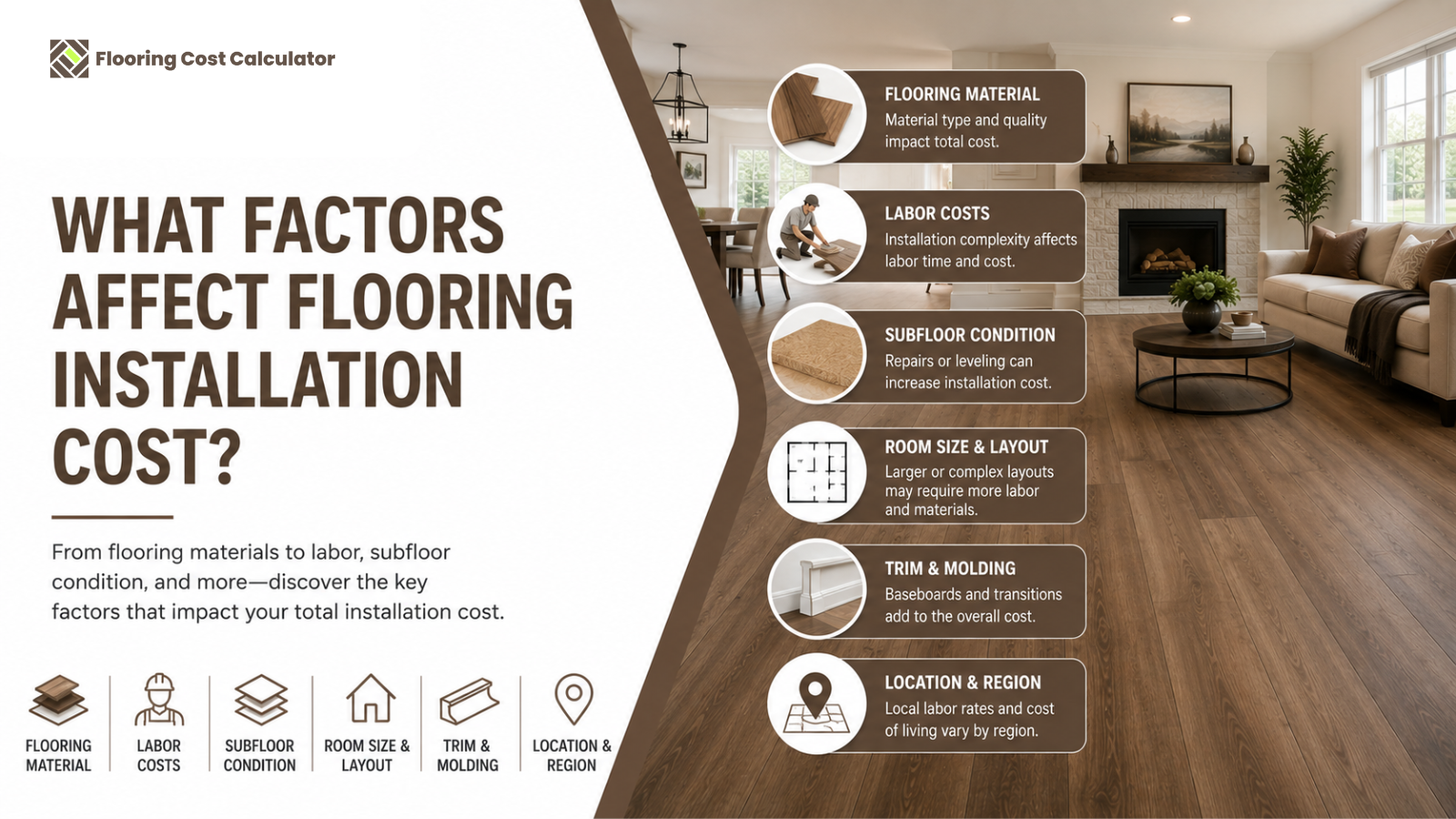
The advertised price may represent only the flooring material. A complete installation can also include professional labor, additional material for cuts and waste, existing flooring removal, disposal, subfloor preparation, underlayment, padding, adhesives, trim, transitions, and other project-specific expenses.
The type of flooring you choose can make a significant difference as well. Laminate may provide an affordable wood-look option, while luxury vinyl plank offers strong moisture resistance and durability at a moderate price point. Hardwood generally requires a larger investment but provides authentic natural beauty and excellent long-term potential. Carpet and tile have their own pricing structures and installation requirements.
Geographic location also matters. Labor rates and overall flooring installation costs can vary considerably from one state to another.
Understanding what is included in the cost per square foot allows you to create a more realistic budget and compare flooring options accurately.
This guide explains flooring cost per square foot, the major factors that influence pricing, and the additional expenses homeowners should consider before beginning a flooring replacement project.
Quick Answer
The total cost per square foot of new flooring depends on several factors, including:
- Flooring material
- Product quality
- Professional labor
- Installation method
- Geographic location
- Existing flooring removal
- Subfloor condition
- Underlayment or padding
- Installation pattern
- Room complexity
The most important distinction is between:
Material cost per square foot
and
Installed cost per square foot
Material cost represents the price of the flooring product itself.
Installed cost represents a more complete estimate that may include the flooring and professional installation.
However, even an installed cost estimate may not include every expense associated with your project.
Always verify exactly what is included before comparing prices.
What Does Flooring Cost Per Square Foot Mean?
Flooring cost per square foot is a pricing method used to estimate the cost of covering a specific floor area.
If a room contains 500 square feet and the flooring costs $5 per square foot, the basic material calculation would be:
500 × $5 = $2,500
However, this does not necessarily mean the entire project will cost $2,500.
You may also need to pay for:
- Additional flooring material
- Installation labor
- Existing flooring removal
- Disposal
- Subfloor preparation
- Underlayment
- Trim
- Transitions
For this reason, homeowners should distinguish between the flooring's retail price and the project's complete installed cost.
Material Cost vs. Installed Cost Per Square Foot
Understanding this difference is essential when comparing flooring options.
Material Cost
Material cost generally refers only to the flooring product.
For example, if flooring is advertised at $4 per square foot, that price may cover only the planks, tiles, or carpet.
It may not include:
- Labor
- Underlayment
- Padding
- Adhesives
- Removal
- Disposal
Installed Cost
Installed cost generally combines the flooring material with professional installation.
Depending on the contractor or retailer, it may also include certain basic installation materials.
However, services such as demolition and extensive floor preparation may still be charged separately.
Before accepting an estimate, ask for an itemized breakdown.
Laminate Flooring Cost Per Square Foot
Laminate is generally one of the more affordable hard-surface flooring options.
It is designed to reproduce the appearance of materials such as:
- Oak
- Walnut
- Maple
- Hickory
Modern laminate products are available in a wide range of colors, plank sizes, surface textures, and quality levels.
Based on the 2026 state-level pricing used by the Flooring Cost Calculator, estimated installed laminate flooring costs generally range from approximately:
$4–$13 per square foot
The exact price depends heavily on location.
For example, lower-cost states may have estimated installed prices beginning around $4 per square foot, while higher-cost locations may reach approximately $13 per square foot.
What Affects Laminate Cost?
Laminate prices can vary depending on:
- Product quality
- Thickness
- Wear resistance
- Water resistance
- Surface texture
- Attached backing
- Installation method
Many laminate products use click-lock floating installation systems, which can help keep installation relatively straightforward.
However, underlayment and subfloor preparation may still increase the total cost.
Luxury Vinyl Plank Cost Per Square Foot
Luxury vinyl plank, commonly called LVP, is one of the most popular flooring materials for modern homes.
LVP combines wood-look designs with practical benefits such as:
- Moisture resistance
- Easy cleaning
- Good durability
- Wide design selection
Based on the 2026 state-level pricing used by the Flooring Cost Calculator, estimated installed LVP costs generally range from approximately:
$5–$18 per square foot
Geographic location plays an important role in determining where a project falls within this overall range.
What Affects LVP Cost?
LVP pricing may depend on:
- Product quality
- Wear layer
- Core construction
- Plank thickness
- Attached backing
- Brand
- Installation method
Some LVP products use floating click-lock installation.
Others require glue-down installation.
These differences can influence both material and labor costs.
Premium products may also provide more realistic textures, improved construction, or enhanced durability.
Hardwood Flooring Cost Per Square Foot
Hardwood is generally one of the more expensive residential flooring materials.
However, many homeowners choose hardwood because it offers:
- Authentic natural appearance
- Unique grain patterns
- Long potential lifespan
- Refinishing potential
- Timeless design
Based on the 2026 state-level pricing used by the Flooring Cost Calculator, estimated installed hardwood flooring costs generally range from approximately:
$8–$28 per square foot
The wide range reflects significant differences in geographic location, material quality, wood species, and installation requirements.
What Affects Hardwood Cost?
Hardwood prices vary depending on:
- Wood species
- Grade
- Plank width
- Finish
- Product quality
- Installation method
Common hardwood species include:
- Oak
- Maple
- Hickory
- Walnut
Premium wood species and wide-plank flooring may cost considerably more than standard options.
Professional installation may involve:
- Nailing
- Stapling
- Gluing
Subfloor preparation can also influence the final installed price.
Carpet Flooring Cost Per Square Foot
Carpet remains a popular choice for bedrooms, family rooms, and other areas where comfort is a priority.
It provides:
- Softness
- Warmth
- Noise reduction
- Comfortable walking surfaces
Carpet prices vary considerably depending on the product.
Important factors include:
- Fiber type
- Density
- Construction
- Quality
- Brand
Common carpet fibers include:
- Polyester
- Nylon
- Triexta
- Olefin
- Wool
Wool is generally considered a premium carpet material, while synthetic fibers are available across a broader range of price points.
When calculating carpet cost per square foot, remember to account for:
- Carpet
- Padding
- Installation
- Existing carpet removal
- Disposal
Stairs and complex room layouts can also increase labor costs.
Tile Flooring Cost Per Square Foot
Tile flooring is commonly installed in:
- Kitchens
- Bathrooms
- Entryways
- Laundry rooms
- Mudrooms
Popular tile options include:
- Ceramic
- Porcelain
- Natural stone
Tile prices can vary enormously depending on the material and design.
Basic ceramic tile may provide an affordable option, while premium porcelain and natural stone can require a significantly larger investment.
Tile installation can also be labor-intensive.
The complete cost may include:
- Tile
- Mortar
- Grout
- Underlayment
- Backer materials
- Waterproofing
- Professional labor
Complex patterns can further increase the cost per square foot.
Flooring Cost Per Square Foot Comparison
The following provides a general comparison of the flooring types covered throughout the Flooring Cost Calculator site.
| Flooring Type | Relative Initial Cost | Installation Complexity | Maintenance | Moisture Resistance |
|---|---|---|---|---|
| Carpet | Low to Moderate | Low to Moderate | Moderate | Low |
| Laminate | Low to Moderate | Low to Moderate | Low | Varies |
| Luxury Vinyl Plank | Moderate | Low to Moderate | Low | Excellent for Many Products |
| Hardwood | High | Moderate to High | Moderate | Limited |
| Ceramic Tile | Moderate | High | Low to Moderate | Excellent |
| Porcelain Tile | Moderate to High | High | Low to Moderate | Excellent |
Actual prices vary by product, contractor, project conditions, and location.
How to Calculate Flooring Cost Per Square Foot
Calculating a preliminary flooring budget begins with measuring the installation area.
For a rectangular room:
Length × Width = Square Feet
For example, a room measuring:
15 feet × 12 feet
contains:
180 square feet
If your estimated installed flooring cost is $8 per square foot:
180 × $8 = $1,440
Your preliminary installed cost would be approximately $1,440.
However, additional expenses may still apply depending on what is included in the per-square-foot price.
Calculating a Low-to-High Flooring Estimate
Using a price range can provide a more realistic preliminary budget.
Imagine your flooring project covers 750 square feet.
Suppose your estimated installed cost is:
$6–$10 per square foot
Calculate the low estimate:
750 × $6 = $4,500
Calculate the high estimate:
750 × $10 = $7,500
Your preliminary estimated project cost would be:
$4,500–$7,500
This provides a useful budgeting range before requesting contractor estimates.
Why You Need More Flooring Than Your Room's Square Footage
Homeowners generally need to purchase more flooring than the exact measured area.
Additional material accounts for:
- Cuts
- Waste
- Damaged pieces
- Installation layout
- Pattern matching
For example, if your room contains 500 square feet, you may need to purchase more than 500 square feet of flooring.
The appropriate amount depends on:
- Flooring type
- Room layout
- Installation pattern
Complex installations generally require more additional material.
The cost of this extra flooring should be included in your material budget.
How Room Size Affects Flooring Cost
The total project cost generally increases as square footage increases.
However, the effective cost per square foot does not always remain identical.
Small projects may have:
- Minimum contractor charges
- Delivery fees
- Setup costs
These expenses are spread across fewer square feet.
Larger projects may sometimes allow contractors to work more efficiently.
For example, installing 1,000 square feet of flooring may not necessarily cost exactly twice as much per square foot as installing 500 square feet.
Always request project-specific pricing.
How Flooring Quality Affects Cost Per Square Foot
Two flooring products made from the same general material can have very different prices.
For laminate, quality differences may involve:
- Thickness
- Wear resistance
- Surface detail
- Moisture performance
For LVP, differences may include:
- Wear layer
- Core construction
- Overall thickness
- Attached backing
For hardwood, price differences may result from:
- Wood species
- Grade
- Plank width
- Finish
For carpet, cost may depend on:
- Fiber
- Density
- Construction
Higher-quality flooring generally increases the material cost per square foot.
How Labor Affects Flooring Cost Per Square Foot
Professional installation can represent a significant portion of the total flooring budget.
Labor requirements vary by material.
Floating laminate and LVP systems may be relatively efficient to install.
Hardwood can require:
- Nailing
- Stapling
- Gluing
Tile may require:
- Layout planning
- Cutting
- Mortar application
- Individual placement
- Grouting
Carpet requires specialized cutting, seaming, and stretching.
More labor-intensive installations generally result in higher installed costs per square foot.
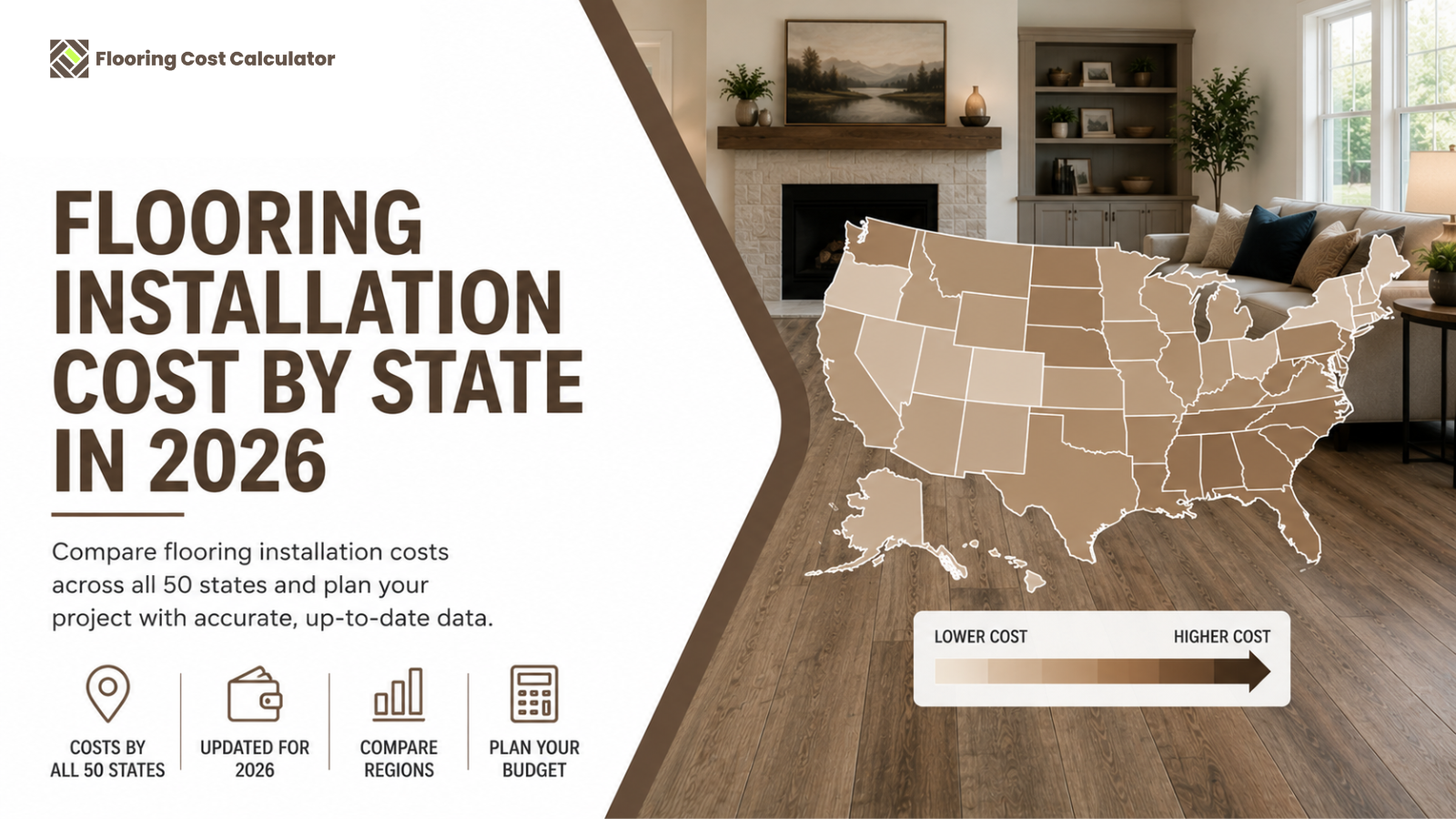
How Location Affects Flooring Cost Per Square Foot
Where you live can have a significant impact on flooring installation costs.
Based on the 2026 state pricing used by the Flooring Cost Calculator, geographic differences can be substantial.
For example, estimated installed laminate flooring ranges from approximately:
$4–$6.50 per square foot in Arkansas and Mississippi
to:
$8–$13 per square foot in Hawaii
Estimated hardwood ranges from approximately:
$8–$14 per square foot in Arkansas and Mississippi
to:
$17–$28 per square foot in Hawaii
Factors contributing to regional differences may include:
- Local labor rates
- Cost of living
- Contractor availability
- Transportation costs
- Regional demand
This is why a location-specific flooring estimate can be more useful than relying exclusively on a single national average.
Existing Flooring Removal Cost
The advertised installed cost per square foot may not include removing your existing floor.
Removal difficulty varies by material.
Carpet may be relatively straightforward to remove.
Tile can be significantly more labor-intensive because installers may need to:
- Break the tile
- Remove mortar
- Clean the substrate
Glued flooring may also require considerable labor.
Ask contractors whether removal and disposal are included in their per-square-foot price.
Subfloor Preparation Cost
New flooring generally requires an appropriately prepared surface.
Potential subfloor problems include:
- Uneven areas
- Cracks
- Loose sections
- Water damage
- Rot
- Structural movement
Minor preparation may be included in some installation quotes.
Significant repairs generally cost extra.
Subfloor condition is one reason the final project cost may be higher than a simple square-foot calculation suggests.
Floor Leveling
An uneven floor may need to be corrected before new flooring is installed.
Floor leveling may involve:
- Grinding high areas
- Filling low areas
- Applying leveling compound
The required level of preparation depends on the flooring material.
Large-format tile may require particularly careful preparation.
Click-lock flooring can also experience performance problems when installed over an excessively uneven surface.
Floor leveling can therefore increase the effective installed cost per square foot.
Underlayment and Padding
Some flooring systems require additional materials beneath the finished floor.
Examples include:
- Laminate underlayment
- Carpet padding
- Moisture barriers
- Tile underlayment
Some flooring products include attached backing, which may reduce the need for separate materials.
Always check manufacturer installation requirements.
When comparing per-square-foot prices, determine whether required underlayment or padding is included.
Installation Pattern
The installation pattern can affect both material and labor costs.
Simple layouts are generally the most economical.
Complex patterns may include:
- Herringbone
- Chevron
- Diagonal layouts
- Decorative tile patterns
These installations can require:
- Additional cutting
- More planning
- Greater material waste
- More labor
As a result, installing the same flooring material in a complex pattern can increase the final cost per square foot.
Room Complexity
Two rooms with identical square footage may have different installation costs.
A simple rectangular room is generally easier to install than a room containing:
- Angled walls
- Multiple closets
- Columns
- Numerous doorways
- Built-in cabinets
- Alcoves
Complex layouts require more measuring, cutting, and fitting.
They can also produce more material waste.
Stairs Are Often Priced Differently
Standard flooring cost per square foot may not accurately represent stair installation.
Stairs require:
- Individual measurements
- Detailed cutting
- Specialized trim
- Additional labor
Contractors may charge per step rather than per square foot.
If your project includes stairs, request separate pricing.
Trim and Transitions
Your flooring project may also require:
- Baseboards
- Quarter round
- Shoe molding
- Transition strips
Transitions are commonly installed where different flooring materials meet.
These materials may not be included in the advertised flooring price.
For large projects, trim and finishing details can add a noticeable amount to the total budget.
Does a Lower Cost Per Square Foot Mean Better Value?
Not necessarily.
Price is only one consideration when choosing flooring.
You should also evaluate:
- Durability
- Moisture resistance
- Maintenance
- Comfort
- Appearance
- Expected lifespan
An inexpensive flooring product that requires early replacement may ultimately cost more over time than a more durable alternative.
Likewise, paying for premium flooring may not make sense if the material is poorly suited to the room.
The best value is generally the flooring that balances initial cost with appropriate long-term performance.
How to Compare Flooring Prices Correctly
When comparing flooring quotes, make sure each estimate covers a similar scope of work.
Ask whether the price includes:
- Flooring material
- Professional installation
- Existing flooring removal
- Disposal
- Subfloor preparation
- Underlayment
- Furniture moving
- Stairs
- Baseboards
- Transitions
- Cleanup
A contractor quoting $7 per square foot may ultimately be more expensive than one quoting $8 per square foot if important services are excluded from the lower price.
Itemized estimates make comparisons much easier.
Example: Comparing Flooring Materials for 1,000 Square Feet
Imagine you are choosing flooring for a 1,000-square-foot project.
Using hypothetical installed prices:
Option A
$6 per square foot:
1,000 × $6 = $6,000
Option B
$10 per square foot:
1,000 × $10 = $10,000
Option C
$16 per square foot:
1,000 × $16 = $16,000
The difference between flooring options becomes increasingly significant as project size grows.
A $4 difference per square foot equals:
$4,000 on a 1,000-square-foot project
This is why comparing cost per square foot is particularly useful when evaluating flooring materials for larger areas.
Common Flooring Cost Per Square Foot Mistakes
Homeowners sometimes underestimate flooring costs by making a few common mistakes.
These include:
- Using material price as the total installed price.
- Measuring the room incorrectly.
- Forgetting additional flooring for waste.
- Ignoring professional labor.
- Forgetting existing flooring removal.
- Ignoring disposal fees.
- Failing to budget for subfloor repairs.
- Forgetting underlayment or padding.
- Ignoring stairs.
- Forgetting trim and transitions.
- Comparing contractor estimates with different scopes of work.
Creating a complete budget helps prevent unexpected expenses after the project begins.
How to Save Money Per Square Foot
There are several ways homeowners may be able to reduce the effective cost of flooring installation.
Consider:
- Comparing multiple contractor estimates
- Choosing flooring appropriate for your budget
- Selecting straightforward installation patterns
- Moving small furniture yourself
- Clearing rooms before installation
- Completing multiple rooms during one project
- Purchasing flooring during promotions
However, avoid reducing costs by skipping essential floor preparation.
Subfloor repairs, moisture treatment, and required underlayment can be critical to the performance and longevity of the finished floor.
Questions to Ask Before Comparing Flooring Prices
Before choosing flooring based on cost per square foot, ask:
- Is this material-only pricing or installed pricing?
- Does the price include professional labor?
- Is existing flooring removal included?
- Does the price include disposal?
- Is underlayment included?
- Is subfloor preparation included?
- Are stairs priced separately?
- Are transitions included?
- Are baseboards included?
- Does the price vary by installation pattern?
- Are there minimum project charges?
Understanding these details can help you compare flooring estimates more accurately.
Frequently Asked Questions
How much does flooring cost per square foot?
The cost depends on the flooring material, quality, installation method, labor rates, and location.
Based on the 2026 state-level pricing used by the Flooring Cost Calculator, laminate ranges from approximately $4–$13 per square foot installed, LVP ranges from approximately $5–$18, and hardwood ranges from approximately $8–$28.
Carpet and tile pricing varies depending on the specific material and installation requirements.
What is the cheapest flooring per square foot?
Laminate and certain carpet products are often among the more affordable flooring options.
However, the total installed cost depends on labor and preparation requirements.
What is the most expensive flooring per square foot?
Premium hardwood and high-end tile or natural stone can be among the more expensive residential flooring options.
Does flooring price per square foot include installation?
Not always.
Some prices represent material only, while others include basic installation.
Always verify exactly what is included.
How do I calculate flooring cost per square foot?
Measure the total installation area and multiply it by the estimated price per square foot.
For a price range, multiply your square footage by both the low and high estimated prices.
Does flooring removal cost extra?
Often, yes.
Some contractors include removal, while others charge separately.
Is underlayment included in flooring cost?
It depends on the contractor, retailer, and flooring product.
Some flooring products also include attached backing.
Why is flooring more expensive in some states?
Local labor rates, cost of living, contractor availability, transportation expenses, and regional demand can all influence installation costs.
Does a complex pattern cost more per square foot?
Generally, yes.
Complex patterns require more planning, cutting, labor, and potentially more material.
Should I choose the cheapest flooring per square foot?
Not necessarily.
Consider durability, maintenance, moisture resistance, expected lifespan, and suitability for the room.
Final Verdict
Flooring cost per square foot is one of the most useful numbers for creating a preliminary flooring budget, but it does not always represent the complete project cost.
Based on the 2026 state-level pricing used by the Flooring Cost Calculator, estimated installed costs for the three primary materials covered by the calculator range from approximately $4–$13 per square foot for laminate, $5–$18 per square foot for luxury vinyl plank, and $8–$28 per square foot for hardwood.
However, your final project cost may also depend on existing flooring removal, disposal, subfloor preparation, underlayment, installation complexity, stairs, trim, transitions, and geographic location.
When comparing flooring options, focus on the complete installed cost rather than the material price alone.
Final Thoughts
Understanding flooring cost per square foot makes it easier to compare materials and estimate projects of different sizes.
Start by measuring the installation area carefully. Then determine which flooring materials meet your budget, design preferences, and practical requirements.
Once you have identified your preferred flooring, calculate a preliminary low-to-high estimate using the expected installed cost per square foot in your state.
Remember that this calculation is only a starting point.
Your home's existing flooring, subfloor condition, room layout, installation pattern, and finishing requirements can all influence the final price. For this reason, contractor estimates should be reviewed carefully to determine exactly which services are included.
A lower per-square-foot price is not automatically the best value. Flooring is a long-term investment, and choosing a material appropriate for the room can be just as important as controlling the initial installation cost.
Before requesting contractor estimates, use the Flooring Cost Calculator on the homepage to estimate your project's cost based on your room size, selected flooring material, and state. A personalized estimate can help you compare flooring costs per square foot, establish a realistic project budget, and approach contractor quotes with a clearer understanding of the potential investment required for your new flooring.